The address is 8 Seongbuk-ro 26-gil, in Seongbuk-dong, Seoul. Behind a small gate beside a stream there is a reformed hanok that the Seongbuk Village Archive dates to around 1933, and for roughly thirteen years after that it was the home and writing room of the novelist Yi Tae-jun (이태준, pen name Sangheo). Today it operates as a teahouse under the name he gave it, Suyeon Sanbang (수연산방), and the City of Seoul designated it a folk heritage property in 1977. You can order tea in the room where he wrote. You cannot find out where he died, because nobody knows.
That gap is the subject of Yi Tae-jun: A Critical Biography (『이태준 평전』), a 456-page hardcover by Ahn Jae-sung (안재성) published by Inmunseowon (인문서원) on October 15, 2026. I want to say up front what kind of post this is. I have not read the book. It came out eight days ago. What I did instead was read everything the publisher has put online, compare it with the two earlier books Ahn has already written about the same man, and check the factual claims in the publisher's copy against public reference sources. The result is less a verdict on the book than a map of what a reader is actually buying, and where the blurb and the record disagree.
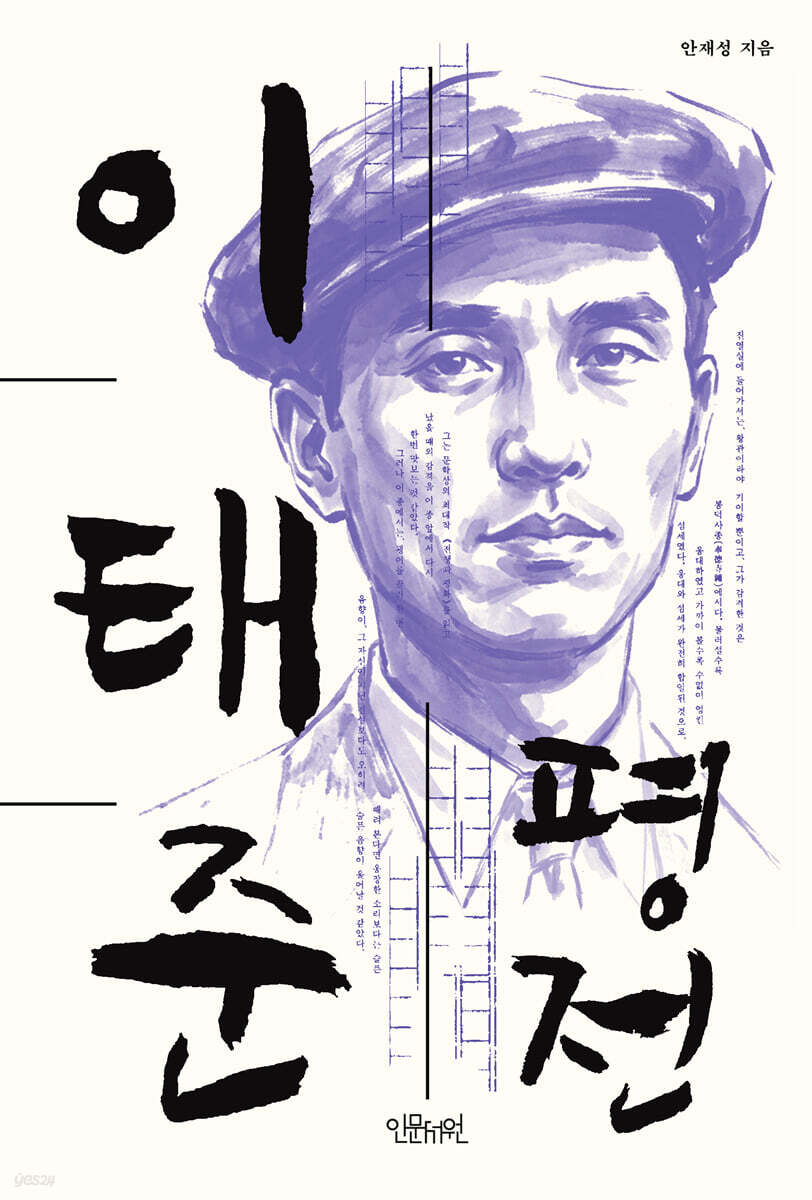
Who Yi Tae-jun was, in the shortest defensible version
According to the Encyclopedia of Korean Culture (한국민족문화대백과사전), Yi was born in Cheorwon, Gangwon Province, in 1904; his death year is listed simply as unknown. His father, a reform-minded local official, fled abroad and died while Yi was a child, and the boy grew up poor. He entered Hwimun High School in 1920, was expelled after leading a student strike, studied for a while at Sophia University in Tokyo, and dropped out. He worked as a magazine reporter at Gaebyeoksa, edited the arts page of the Joseon Jungang Ilbo, co-founded the literary circle Guinhoe (구인회) in 1933 with writers including Jeong Ji-yong and Kim Gi-rim, and from 1939 to 1941 ran Munjang (문장), the literary monthly that, in the encyclopedia's words, discovered capable new writers. In 1946 he went north. The encyclopedia entry stops there.
Those are the bones. What makes him matter to Korean readers is the prose. The publisher's copy leans on the labels he has collected over the years: "the saint of style," "the completer of the Korean short story," "Korea's Chekhov." Those are reputational claims, not facts, and I am not going to adjudicate them. But they do explain why a 456-page biography of a writer whose last decades are a blank can find a publisher in 2026.
This is Ahn Jae-sung's third book about the same man
The publisher's description of the new book does not mention it, but Ahn has been here twice before. The author bio on the same product page lists In Search of the Missing Writer Yi Tae-jun (『실종작가, 이태준을 찾아서』), and a search of the same bookstore turns up a third title: The Sea of the Moon (『달의 바다』), a 2013 young-adult novel about Yi's childhood. Laying the three tables of contents side by side is the most useful thing I can offer a prospective reader, so here it is.
| The Sea of the Moon (2013) | In Search of the Missing Writer (2015) | Critical Biography (2026) | |
|---|---|---|---|
| Publisher | Bookmentor (북멘토) | Pureunsasang (푸른사상) | Inmunseowon (인문서원) |
| Form | Young-adult novel | Biographical narrative | Biography (평전) |
| Pages and trim | 292 pages | 320 pages, 142 x 224 mm | 456 pages, 128 x 188 mm |
| Chapters | 15, from "마우재의 땅" (Land of the Russians) to "현해탄" (the Korea Strait) | Preface plus 15, from "부산항" (Busan Port) to "실패자들" (The Failures) | Preface plus 22, from "마우재의 땅" to "불타는 책" (The Burning Book) |
| List price | Not checked | 18,500 won | 25,000 won |
Several chapter titles carry straight over. The 2026 book opens with "마우재의 땅" (Land of the Russians), the exact title of the first chapter of the 2013 novel. "원산 객주" in 2013 becomes "원산 물산객주" in 2026. From the 2015 book, "배기미" becomes "배기미 항구," and "부산항," "구인회," "가마귀작전" and "종군작가들" reappear almost unchanged as "부산항," "구인회," "가마귀 작전" and "종군작가단." Matching titles do not prove matching text, and I have not compared any pages. But the shape is clear enough: the new book reads, on its contents page, like the 2013 childhood narrative and the 2015 adult life joined end to end, plus chapters whose titles have no counterpart in either earlier contents page, among them "만주기행" (Manchuria travels), "우리말, 우리글" (Our Speech, Our Script), "소련기행" (Soviet travels) and "평양의 카프 작가들" (The KAPF writers of Pyongyang).
One small arithmetic check on the "much longer" impression. The raw page count jumps from 320 to 456, which looks like 43 percent more book. But the 2026 edition uses a noticeably smaller trim. A 128 x 188 mm page has about 76 percent of the area of a 142 x 224 mm page, so 456 small pages are roughly equivalent to 345 of the 2015 pages, about 8 percent more. Typeface and line spacing could push that number either way, so treat it as a rough indicator rather than a word count. Still, a reader who already owns the 2015 book should not assume the new one is half again as long.
None of this is a scandal. Biographers revise; Ahn may have found new material in the eleven years between editions. My complaint is narrower. A buyer reading the publisher's description has no way of knowing that this is a reworking of territory the author has published on twice, and that is something a description should say.
Checking the publisher's claims against the record
I took every checkable factual statement from the publisher's review and compared it with the reference sources listed at the end of this post. I also compared it with what the publishers of Ahn's own earlier books said, because the most interesting disagreements turned out to be internal.
| Claim in the 2026 publisher copy | What I found | My read |
|---|---|---|
| Born in 1904 in Cheorwon, Gangwon | The Encyclopedia of Korean Culture gives 1904 and Cheorwon. | Matches |
| Went to Hwimun High School and left after a student strike | The encyclopedia says he entered in 1920 and was expelled for leading the strike. | Matches |
| Debuted when "Omongnyeo" (오몽녀) was selected by the magazine Joseon Mundan | The encyclopedia says he began his career by publishing "Omongnyeo" in the newspaper Sidae Ilbo in 1925. | Two accounts name two different venues. They may describe two different events, a selection and a publication, but the blurb gives only one. |
| "About 60 short stories" and "about 10 novellas and novels" | The 2015 book's own excerpt says "13 newspaper serial novels and about 70 short stories." | The author's two books disagree on the count. I could not resolve which is current. |
| Treated as a pro-North figure in the South and shunned until his 1988 haegeum (해금, lifting of the ban) | The National Institute of Korean History chronology records that on July 19, 1988 the culture ministry cleared the pre-liberation works of about 120 writers who had gone north, naming Yi among them; five writers were excluded. | Correct, with a qualifier the blurb omits: the July 1988 announcement covered work written before August 15, 1945. |
| Wrote Sasang-ui Wolya (사상의 월야) and "Haebang Jeonhu" (해방 전후) in 1946 | The encyclopedia dates Sasang-ui Wolya to 1946 and "Haebang Jeonhu" to the August 1946 issue of Munhak. | Matches |
| Purged in the North and died there | The encyclopedia lists his death year as unknown. The 2015 book's publisher says when and where he died is not known; the 2013 novel's publisher says he is "known to have died in the 1970s." | Purge is consistent across sources. The date is not, even within the author's own catalogue. |
The qualifier on the 1988 ban-lifting is worth a sentence of its own, because it bears directly on this book. The two 1946 works the publisher calls close to autobiography, and the Soviet travelogue (『소련기행』) that the 2015 book describes as what truly shocked his readers, were all written after liberation. The July 19, 1988 announcement as recorded in the national chronology does not cover them. I am not claiming they stayed banned after that date; I did not find a record either way. I am pointing out that "unbanned in 1988" is a simplification, and a biography that leans on those 1946 texts ought to explain their status.
There is one more disagreement, and it is the one I would most like the new book to settle. The 2013 publisher wrote that the colonial authorities pressed Yi to write fiction in Japanese and that he "refused to the end." The 2015 publisher, describing the same author's research two years later, wrote that he "ended up writing one story in Japanese" and then withdrew to his hometown until liberation. The Hankyoreh's 2015 review of that book repeats the second version. These cannot both be right. The 2026 description says nothing about it either way.
The verdict the publisher wants you to take away
The publisher's copy ends on a judgment that is plainly Ahn's: Yi was neither a socialist revolutionary nor a nationalist patriot, but an upright, scholar-like man without the courage to throw himself against injustice, a timid intellectual who ended up a casualty of ideology. It also pitches the book as a way to understand today's left-right conflict "more macroscopically."
I have three reservations, all of which the book may answer, but none of which the description does.
First, the sources for the North Korean years. The Hankyoreh review of the 2015 book said plainly that the account "grows thin" from the 1946 crossing onward, because Yi stopped producing work that revealed his inner life and the author's inference took over. It added that the gap was filled partly by Ahn's critical assessments of Stalin and Kim Il-sung. The 2015 publisher itself conceded that the late-life portrait drew on testimony from North Korean agents sent south and from defectors, and that the author had to rely on conjecture in many places. The 2026 contents page now gives six of twenty-two chapters to the post-liberation years. Unless new documents surfaced between 2015 and 2026, a longer section built on the same thin base is still a thin section. This is the single thing I would check in a bookstore before buying: the notes for chapters 17 to 22.
Second, novels as evidence. The publisher says Sasang-ui Wolya and "Haebang Jeonhu" are so realistic that, apart from the protagonists' names, they can be read as autobiography. That is a common move in Korean literary biography and it is defensible as far as it goes. But "Haebang Jeonhu" was published in August 1946, the year Yi went north, and it narrates a writer's choices in the final years of the occupation. It is precisely the kind of text a writer would shape. A biography that uses it as a record of what happened, rather than as Yi's own case for himself, inherits his framing.
Third, the "timid intellectual" verdict. It is a reasonable reading, and it is more generous than the Cold War verdict that kept his books off shelves for decades. But it is a moral judgment presented as a conclusion of research, and the strongest evidence for it in the earlier book was the Japanese-language story that the 2013 copy says he never wrote. If the factual premise is contested in the author's own catalogue, the verdict built on it deserves a footnote.
For balance: Ahn is not a writer with an anti-left axe to grind. His author bio describes a career in the labor movement, including work at the Cheonggye garment workers' union and a long association with the Jeon Tae-il Literary Award, which he won in 1989 and later helped run, and his other biographies cover Korean communists such as Park Heon-young and Lee Hyun-sang. When a writer with that background is unsparing about Stalinism, it carries more weight than the same judgment from the other side. That is a genuine reason to take the book seriously.
Why this one landed on a Seongbuk-gu blog

Most of the Korean-language writing on this blog lately has been neighborhood history from Gireum-dong, a few neighborhoods over in the same district. That work makes a biography like this one read differently. Yi's 1933 story "Dalbam" (달밤, Moonlit Night), published in the magazine Jungang, opens with a narrator who has just moved out to Seongbuk-dong from inside the old city walls. A few lines in he says, "여기도 정말 시골이로군!" (So this place really is the countryside!). The Encyclopedia of Korean Culture's entry on the story describes the same move from inside the gates to Seongbuk-dong.
That line lines up neatly with what I found researching the Miari public cemetery in Gireum-dong, which operated from 1928 to 1958 on the city's northern outskirts. In the same years that Yi's narrator was marveling at how rural Seongbuk-dong felt, the city was burying its dead elsewhere in what is now the same district. The district was where Seoul put the things it did not want in the center, and it was also where a successful novelist could afford a garden and a stream. A good biography should be able to place him on that map.
I also owe a correction. An older post here, on Gireum-dong and Donam-dong as a refuge for artists, lists Yi Tae-jun among the writers who lived in Donam-dong. The house record I can verify, from both the Seongbuk Village Archive and the encyclopedia, places him in Seongbuk-dong from 1933 to 1946. I have not found a source for a Donam-dong residence, so I would treat that older sentence as unconfirmed until one turns up.
The language chapter is the one I most want to read
Chapter 15 of the new book is titled "우리말, 우리글" (Our Speech, Our Script). The publisher's copy says Yi avoided foreign words and even difficult Sino-Korean vocabulary, refused English- and Japanese-style sentence patterns, and wrote in the Korean that ordinary people actually spoke. The 2015 Hankyoreh review adds the story, from Ahn's earlier research, that at a forced 1941 pro-Japanese lecture in Pyongyang Yi spoke in Korean and read a passage from Chunhyangjeon instead of praising the emperor.
Last week I wrote about Kim Seul-ong's Hangul Is Hallyu, a book that treats the alphabet as an engine of the Korean Wave. Yi Tae-jun is a useful counterweight to that kind of argument. His attachment to the language was not about global reach; it was about a colonized writer keeping a literary Korean alive while, as the publisher puts it, the Japanese were trying to wipe the language out. If Ahn's chapter documents that with dated sources rather than anecdote, it will be the strongest part of the book.
Book facts
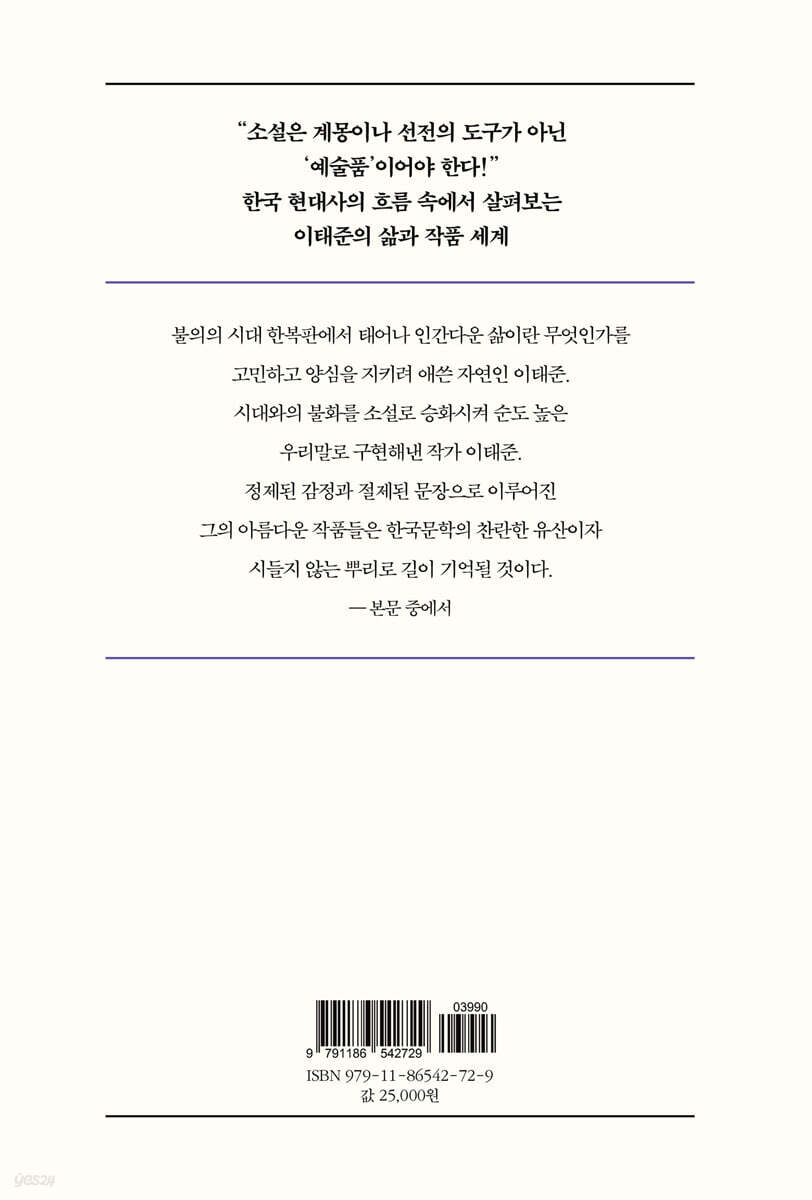
- Title: 이태준 평전 (Yi Tae-jun: A Critical Biography)
- Author: Ahn Jae-sung (안재성), novelist and biographer, born 1960 in Yongin
- Publisher: Inmunseowon (인문서원)
- Published: October 15, 2026
- Format: Hardcover, 456 pages, 128 x 188 mm
- ISBN: 9791186542729
- List price: 25,000 won
- Back matter: chronology and list of major works, according to the contents page
Short answers to likely questions
Is this a translation? No. It is written in Korean by a Korean author, and as far as I can tell there is no English edition.
I own the 2015 book. Do I need this one? Based only on the contents pages, the new book adds a childhood section that overlaps the author's 2013 novel and several new chapters on the 1930s and the North Korean years. Whether it adds new evidence for the North Korean years is the question I could not answer without the book.
Can I visit the house? Yes. It is a designated folk heritage property and currently runs as a teahouse called Suyeon Sanbang at 8 Seongbuk-ro 26-gil.
Where should a first-time reader of Yi Tae-jun start? With the stories, not a biography. "Dalbam" is short, set in the same neighborhood as the house, and the encyclopedia entries for both the story and the author are free to read.
If I could ask the publisher one thing
It would be this: what is new since 2015? A one-paragraph note saying which chapters are rewritten, which are new, and what documents the author found after In Search of the Missing Writer would make this a far easier book to recommend. Without it, the honest description is that this is the fullest version so far of a life Ahn Jae-sung has been writing for thirteen years, with the same dark stretch at the end that every account of Yi Tae-jun has. I have not read it, so I am not grading it. I am only saying that the questions in the tables above are the ones I would bring to it.
Sources checked for this piece
- YES24, 『이태준 평전』 product page (publisher description, contents, specifications, 2026): https://www.yes24.com/product/goods/197707268
- YES24, 『실종작가, 이태준을 찾아서』 product page (Pureunsasang, 2015): https://www.yes24.com/product/goods/20279155
- YES24, 『달의 바다』 product page (Bookmentor, 2013): https://www.yes24.com/product/goods/9148875
- Hankyoreh, "조선말을 사랑한 선비 작가 이태준" (review of the 2015 book, 2015): https://www.hani.co.kr/arti/culture/book/711074.html
- Academy of Korean Studies, Encyclopedia of Korean Culture, "이태준": https://encykorea.aks.ac.kr/Article/E0046336
- Academy of Korean Studies, Encyclopedia of Korean Culture, "상허 이태준 가옥" (including the KOGL Type 1 photograph used above): https://encykorea.aks.ac.kr/Article/E0029340
- Academy of Korean Studies, Encyclopedia of Korean Culture, "달밤": https://encykorea.aks.ac.kr/Article/E0070471
- Seongbuk Village Archive (성북마을아카이브), "수연산방": https://archive.sb.go.kr/isbcc/home/u/story/view/775.do
- National Institute of Korean History, Chronology of the Republic of Korea, July 19, 1988 (citing the Kyunghyang Shinmun of that date): https://db.history.go.kr/id/tcct_1988_07_19_0010
- "Dalbam" full text, for the opening line quoted above: davincimap.co.kr
