Near the end of this book there is a set of funeral instructions. No funeral, no announcement, no condolence money. Cremation, then ashes scattered at sea. After that, the family should stand in the sea wind for a while and go and eat something hot together, and nobody should hold a memorial of any kind. It closes with a line in English, "Keep calm and carry on writing," and then, in Korean, a promise that we will surely meet again.
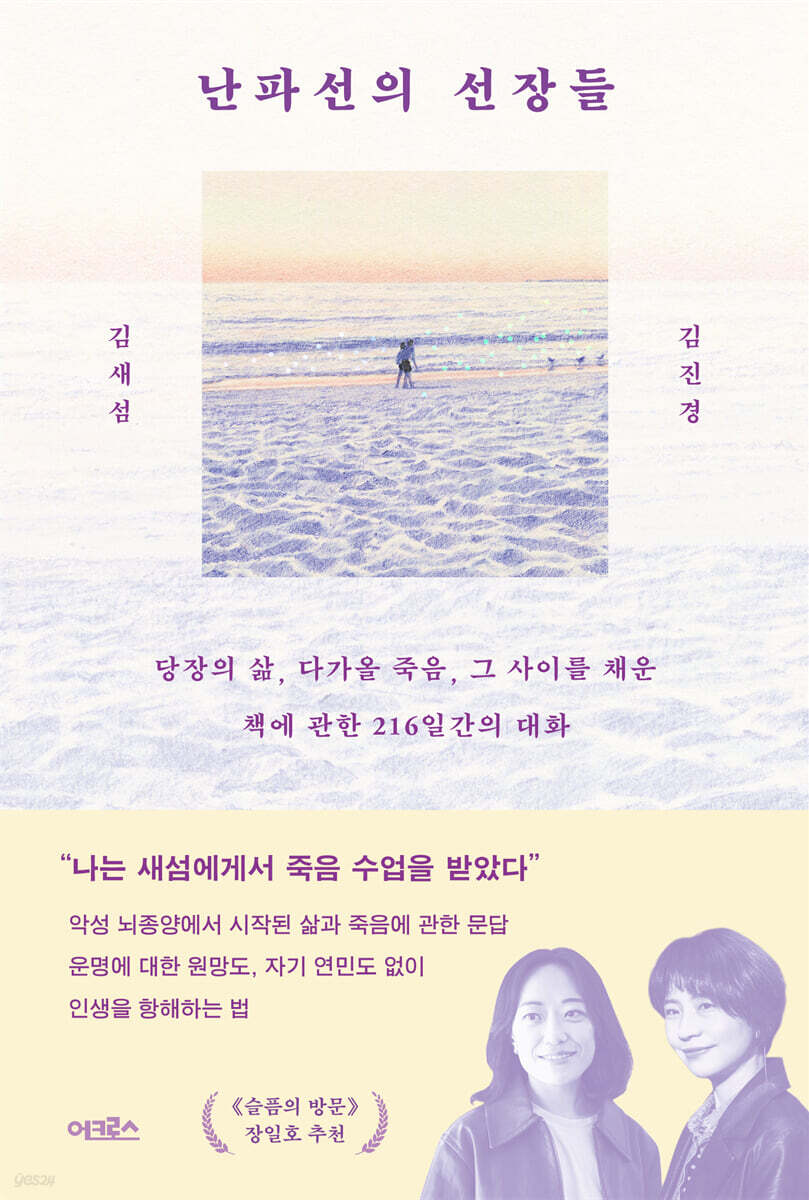
The person who wrote those instructions is not a character. She is Kim Sae-seom (김새섬), founder of the Korean online book club platform Geumeum (그믐), who was diagnosed with glioblastoma, the most aggressive form of brain cancer, in April 2025. Captains of the Shipwreck (난파선의 선장들), which she co-wrote with the journalist Kim Jin-kyung (김진경), is the record of the conversations the two women had about dying, living, and the books that helped them think about both. It is one of the quietest new Korean releases of September 2026, and one of the few I have come across this year that I would hand to someone without any caveat about genre.
Who is on each end of the phone line?
Kim Sae-seom spent her early career in the finance departments of several foreign companies in Korea. In 2022 she left to build something around the thing she loved most, reading, and launched Geumeum, a platform where readers gather online to work through books together. She is married to the novelist Jang Kang-myung (장강명), one of the better-known names in contemporary Korean fiction. After her diagnosis, she chose to go public rather than go quiet: she spoke on the lecture programme Sebasi (세바시), wrote for the JoongAng Ilbo, and, about a month after her first surgery, started a podcast with her husband called The Odyssey of Cancer and Books (암과 책의 오디세이).
Kim Jin-kyung studied Korean and Chinese literature at Yonsei University and worked as a reporter at the JoongAng Ilbo before moving to Zurich, where she raises two children and studies internet platforms and social change at the University of Zurich. She heard the podcast from Switzerland, was struck by how little self-pity there was in it, and emailed a proposal: pick a passage from a book about death, and use it as the opening question. Kim Sae-seom's reply was short and enthusiastic.
According to Yonhap's report on the book's release, what both expected to be one or two interviews became twelve phone calls between September 2025 and April 2026. That timeline matters. This is not a memoir written in hindsight. It is a conversation conducted while the outcome was still unknown, and the same report notes that Kim Sae-seom's condition worsened and she underwent a second operation in June 2026.
What exactly will you be holding?
- Korean title: 난파선의 선장들 (my working English translation: Captains of the Shipwreck)
- Authors: Kim Sae-seom (김새섬) and Kim Jin-kyung (김진경)
- Publisher: Across (어크로스)
- Publication date: 18 September 2026
- Length: 288 pages, 17 chapters in four parts
- ISBN-13: 9791167743312
- List price: KRW 17,800
- English edition: not confirmed. I could not find any announced translation.
The four parts move in a clear arc: "Before Death" (self-pity, unfairness, disgust, fear, memento mori), "How to Live" (a good death, the legacy of an ordinary person, and three conditions for a good life), "Beside Pain" (morphine, a family death, and the chapter that gives the book its title), and finally "Setting Sail Again," which ends with a chapter simply called "Why Read."
Why "why not me?" is a harder question than "why me?"
The first book the two women use as a stepping stone is Tolstoy's The Death of Ivan Ilyich. Ivan is a judge in his forties who has lived a respectable life and cannot understand why he, of all people, has been singled out. What he wants most is for someone to pity him the way you would pity a sick child. It is an uncomfortable portrait because it is so recognisable.
Kim Sae-seom's answer to Ivan comes from the Tao Te Ching: heaven and earth are not kind, and they treat all things as straw dogs, the ritual figures that are honoured and then thrown away. Her point is not bleak. She says, more or less, that she is enormously precious to herself, and a cut finger hurts terribly, but the world was never arranged around her. Car crashes, rare diseases, wars: why should all of that pass her by? What makes her the exception?
What I find useful here is that she does not pretend self-pity is shameful. She treats it as a normal human reaction and then declines to live inside it. Once the straw-dog idea removes the sense of personal injustice, a more practical question takes its place: if this life is made of straw, what is worth spending it on? That pivot, from grievance to allocation, is the hinge the whole book turns on.
Autonomy, relationships, meaning: are three conditions enough?
In the second part, the talk about a good death quietly becomes a talk about a good life. Kim Sae-seom names three conditions. The first is autonomy paired with responsibility, the freedom to decide for yourself and the diligence to answer for it. The second is relationships, and she names two people: a mother who treated her with the same steadiness through a childhood spent in urban poverty, and the husband she describes as the family she chose. The third is the pursuit of meaning, which she says sharpened after the diagnosis. There is a striking line in the publisher's material that a glioblastoma patient's time runs at roughly forty times the speed of other people's.
On paper, this list is not new. Anyone who has read Atul Gawande's Being Mortal, or the palliative-care literature it draws on, will recognise the shape. Where the book earns its keep is in Kim Jin-kyung's observation about consistency. The attitude Kim Sae-seom brings to dying is the same one she brought to leaving a stable finance job to start a book club in her forties. Nothing was reinvented for the occasion. That is a more demanding lesson than a three-item checklist, because it suggests the preparation for a good death is mostly done years in advance, in how you decide ordinary things.
My one reservation: a framework built from a single, unusually composed person risks reading as a standard the rest of us will fail. Kim Sae-seom herself says her calm is probably just temperament. I would have liked a little more space for readers who will not be calm, and I cannot yet tell from the material available whether the later chapters on morphine and family death provide it.
Is Korea finally ready to talk about dying out loud?
Some context for readers outside Korea. Death has long been a subject Korean families handle through ritual rather than conversation, and the funeral industry here is elaborate and expensive. That has been shifting. Since Korea's life-sustaining treatment law took effect in 2018, adults can register an advance statement refusing futile end-of-life treatment, and "well-dying" (웰다잉) has become a common phrase in public health campaigns and community centre classes. Bookstores have followed: essays by hospice doctors, funeral directors, and people writing through their own illness now sit on the front tables.
My honest view of that wave is mixed. A lot of it is gentle, well-meaning, and interchangeable, the kind of book whose title you forget before you reach the till. What separates this one is the format. It is not one person's diary or one expert's advice, but two readers who disagree, joke, and change their minds on the phone across a seven- or eight-hour time difference. The dialogue form keeps it from becoming a sermon. And the fact that it grew out of a podcast, and then a book club platform, says something about where Korean reading culture has moved: from the solitary reader toward readers who think out loud, together, online.
How it sits beside what I have reviewed recently
This book keeps pulling me back to a few earlier posts on this site. Reframe (리프레임), the former Samsung SDI CEO's guide to the thirty years after retirement, asks how to design a long life whose final chapter you can see coming. Captains of the Shipwreck asks the same question with the timescale brutally compressed, and I think the answers overlap more than either author would expect: both land on autonomy and meaningful work as the things that hold a life together.
It also connects to Dementia or Depression?, Hideki Wada's book on the aging mind, which is at heart about not mistaking a treatable state for an inevitable one. Kim Sae-seom's distinction between pain you can fight, which takes courage, and pain you have to accept, which takes wisdom, is the emotional version of the same clinical point. And for anyone who reads this and then lies awake, the CBT guide to racing thoughts at midnight I reviewed earlier this month is a surprisingly practical companion.
There is a personal angle too, and it is a small one. I review a Korean book on this blog three times a week, and the last chapter, "Why Read," made me a little uneasy about how fast that pace is. Kim Jin-kyung's argument is that literature is useful even for the last desire a living person has, the question of how you want to die, because books give you examples to accept and examples to refuse. That is a much slower, more serious use of reading than skimming a new release for a review. I do not have a neat resolution to that, but I noticed it.

Who should pick this up, and who might wait?
It will suit readers who already use books to think through hard things, anyone caring for a seriously ill parent or partner, and people who found Being Mortal or Paul Kalanithi's When Breath Becomes Air helpful and want a Korean counterpart. It will also interest anyone curious about Korea's newer, community-driven reading culture. It is probably not the right book for someone in the first raw weeks after a diagnosis of their own. The composure on the page is real, but it may feel like a bar set too high if you are not there yet.
Questions readers are likely to ask
Is this a sad book?
It is about death, so yes, in places. But the publisher and the press coverage both note that the two women increasingly laughed and joked as the calls went on, and the tone is closer to a long, frank conversation between friends than to grief writing.
Do I need to have read the books they discuss?
No. The books, from Tolstoy to the Epic of Gilgamesh, are used as conversation starters, and the relevant passages are introduced in context.
How is it connected to Jang Kang-myung?
Jang Kang-myung is Kim Sae-seom's husband and co-host of her podcast. He is part of the story but not a co-author. He has separately published an autobiographical novel drawn from the same events.
Is there an English translation?
Not that I could confirm. At the time of writing, it appears to be available in Korean only, in print and as an e-book.
Before I close this one
I should be straightforward about how far I have got. I have not read all 288 pages. What I have worked through is the table of contents, the publisher's material and excerpts, the authors' own statements, and the press coverage around the release, and the section on the three conditions is where I have spent the most time. I will not pretend otherwise, and given the subject, pretending would feel especially wrong.
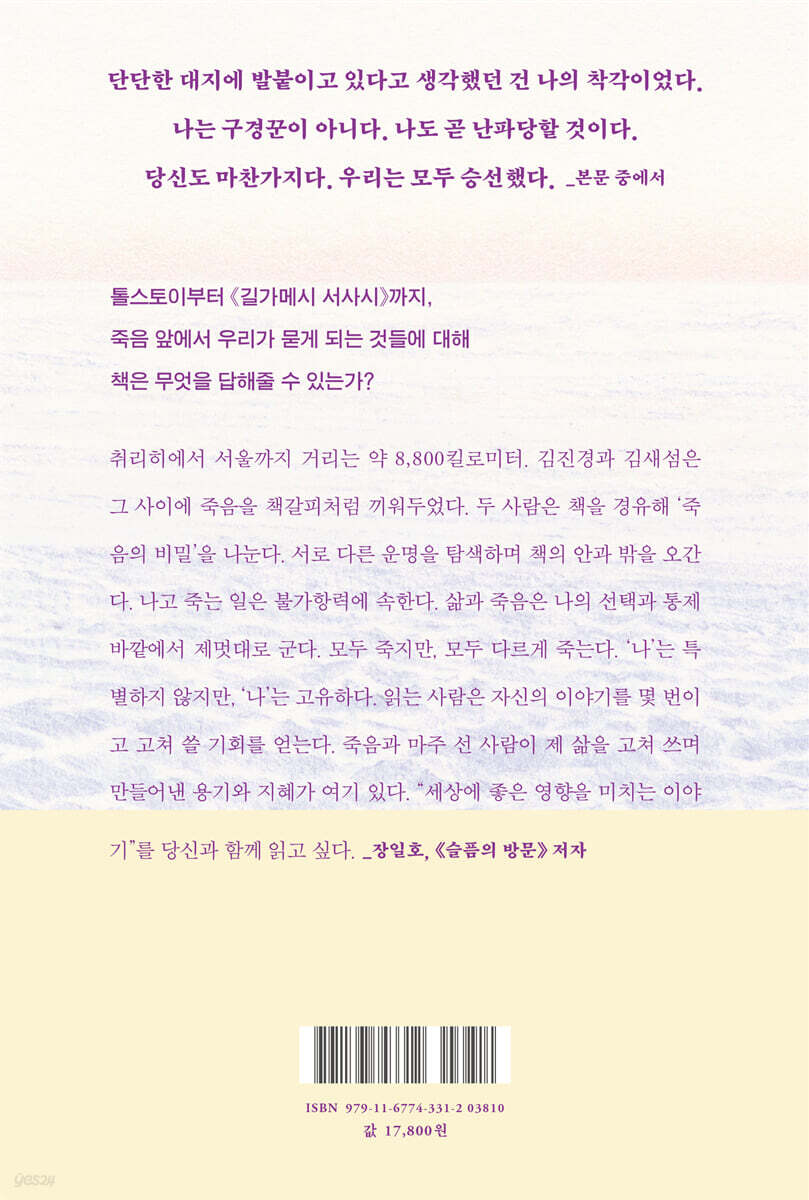
What stays with me is the image the title comes from. When the calls began, Kim Jin-kyung thought of Kim Sae-seom as the captain in the storm and herself as a spectator on the shore. By the end she realised there is no shore. Everyone is on a ship that will eventually go down, and some of us simply know the forecast earlier. That is not a comforting thought, exactly, but it is an honest one, and this is an honest book built around it.
Book details and excerpts referenced from the YES24 product page. Publication timeline details from Yonhap News (21 September 2026).
