Every spring and autumn, Korean publishers release a book written by whoever scored highest on the previous year's college entrance exam. Most of them are forgettable. The Study That Is Most Like Me (가장 나다운 공부), out from Woongjin Knowledge House (웅진지식하우스) on 17 September 2026, is the newest entry in that genre, and the reason I stopped on it is not the perfect score on the cover. It is the title's refusal to promise a method.
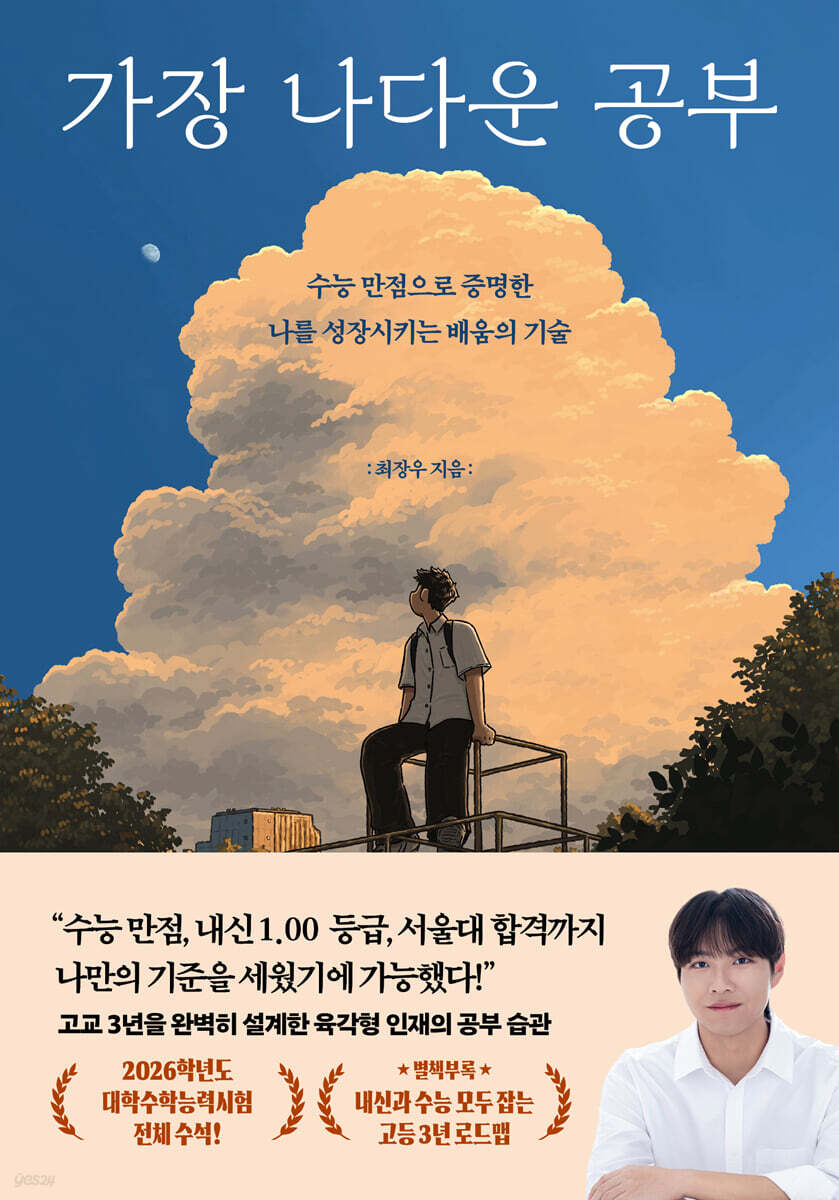
Korea publishes a top-scorer study book almost every year. Why bother with this one?
I want to be honest about my prior here, because it shapes everything below. The Korean study-method shelf is one of the most commercially reliable categories in the country's publishing industry, and it is built on a statistical fallacy that nobody in the supply chain has any incentive to point out. You take the single student at the top of a 400,000-person distribution, ask them what they did, and sell the answer as a causal recipe. The 399,999 students who did roughly the same things and did not finish first are never interviewed. That is survivorship bias with a barcode on it.
So the question I brought to this book was not "what is his secret." It was "does the author know that his own book has this problem?" Based on the table of contents and the publisher's material, he at least behaves as though he does. The framing is not copy this but here is how I kept revising until something fit, and the final part of the book is about recovering from bad results rather than avoiding them. That is a meaningfully different posture from the genre norm, and it is why I am writing about it instead of the other two study books that came out the same week.
The short version, for readers who will not scroll
Choi Jang-woo (최장우) scored full marks across every subject on the 2026 CSAT, the exam year Korean media nicknamed the "ice-cold" test for its difficulty, and topped the national standardised-score ranking as a humanities-track student. His book is not a subject-by-subject cram guide. It is organised around six ideas in sequence: motivation, ownership, method, routine, school life, and emotional recovery. The recurring argument is that a study method is a hypothesis you test on yourself and discard when it fails, not a product you buy. Whether that argument survives contact with a student who is not already gifted is, I think, the open question the book does not fully answer.
Who the author actually is
Choi is unusual within the genre because his record is not purely academic. Alongside the perfect CSAT score and a 1.00 grade-point average, he served as his school's student body president and as chair of the Gwangju Metropolitan City high school student assembly, and he entered Seoul National University's economics faculty directly from school without a gap year. Korean commentators labelled him a "hexagonal talent," the local shorthand for someone with no weak axis. He appeared on the variety programme You Quiz on the Block, on MBC's morning news, and on the education YouTube channel Mimimino, where a clip of him solving a hard maths problem mentally in about five seconds circulated widely.
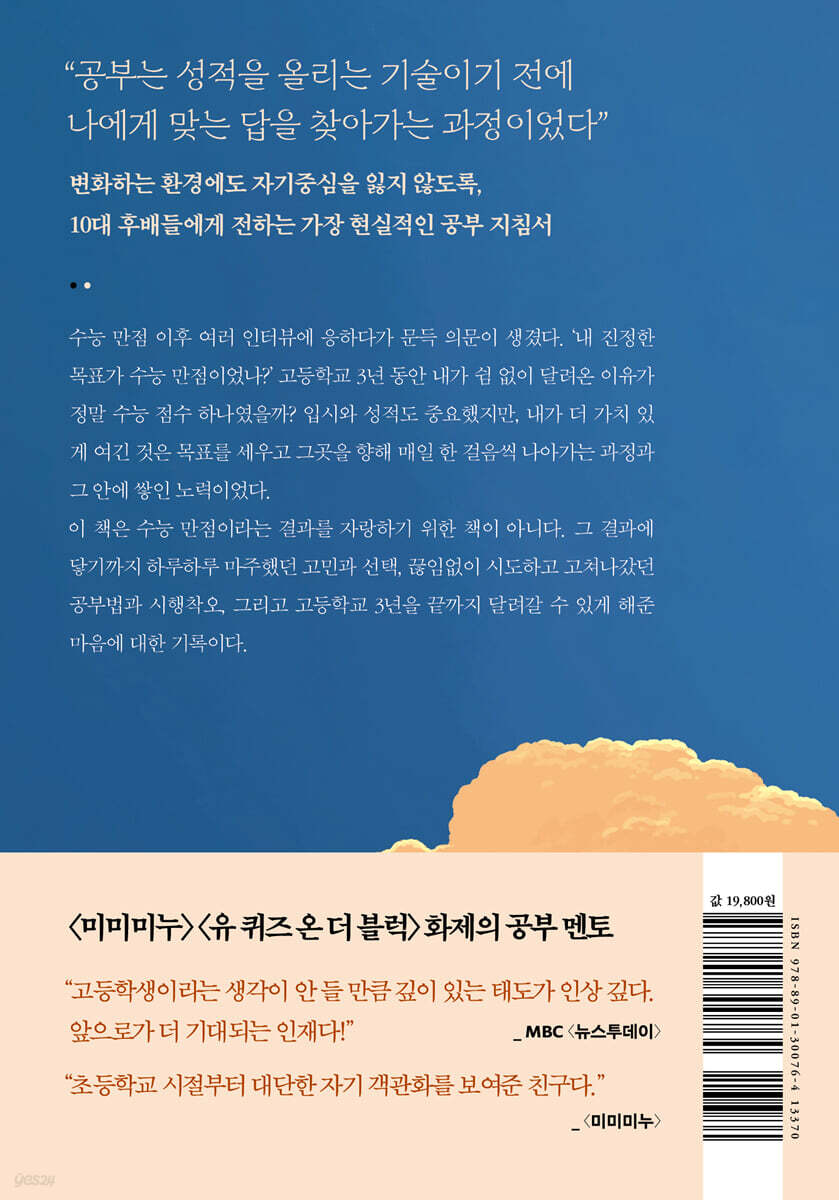
The detail I find most telling is one the publisher highlights: the sentence he says he heard most often from his parents was not "go study" but "why do you want to do that?" Whether or not you believe that is the whole explanation, it tells you which lever the book is going to pull.
The problem the book is really circling
Strip away the exam context and the book is about a failure mode that has nothing to do with Korean teenagers specifically: doing a large volume of work that produces no measurable improvement. One chapter title translates roughly as "I solve the workbooks fine, so why do I do badly on the test?" Another asks "I feel like I studied a lot, so why haven't my marks moved?" Anyone who has run a gym programme, practised an instrument, or ground through a professional certification recognises both of those questions immediately.
His diagnosis is that most students are optimising for the sensation of effort rather than for the transfer of skill, and that the gap is invisible from the inside. Hence the instruction to look at yourself "through a third party's eyes," and hence the emphasis on written records that can be checked later against outcomes.
Concept one: keep a solution notebook, not an error notebook
The single idea I expect to be quoted most from this book is his rejection of the 오답 노트, the error notebook, which is close to a national institution in Korean secondary education. The standard practice is to copy every question you got wrong into a dedicated book and revisit it. Choi argues for a 풀이 노트 instead, a solution notebook, in which you write the reasoning path you actually used, including on questions you answered correctly.
The logic is sharper than it first sounds. An error notebook records outcomes; a solution notebook records process. If you got a question right through a lucky guess, a half-remembered pattern, or a method that will collapse under time pressure, the error notebook will never catch it, because the answer was correct. Only a record of reasoning exposes that. Pair that with his five-step framework for working through unfamiliar problems and you get a fairly coherent thesis: the unit of study is the reasoning move, not the question.
Concept two: do not trust yourself, trust the plan
The routine section opens with a line that reads, translated, as "don't believe in yourself, believe in your plan." It is a deliberately unromantic claim for a motivational book, and it is the part I would defend hardest. His practical corollaries are that a plan you wrote once and never revised is not a plan, that recording your hours is not the same as auditing them, and that the leaks in a study day are usually in the transitions rather than in the blocks.
What raises this above generic productivity advice is the insistence on revision cycles. The book treats a study schedule the way an engineer treats a spec: something to be versioned. That is the connective tissue between the method chapters and the emotional ones at the end, because if your plan is a living document, a bad exam result is data rather than a verdict.
The part I am sceptical about
Here is my own history with this kind of book, and it is not flattering. In my late twenties I collected study-method books the way other people collect gym memberships. I once spent the better part of a weekend rebuilding my note system after reading a Korean bestseller about spaced repetition, complete with colour-coded index cards I bought specially, and I abandoned the whole apparatus within eleven days because I had optimised the container instead of doing the work. That episode is the reason I now read this genre with a particular suspicion: the more satisfying a method feels to set up, the more likely it is to be procrastination in a cardigan.
Reading the contents of this book, I can see exactly where that trap sits. A "solution notebook" is enormously appealing to build and quietly expensive to maintain. The book, as far as I can tell from its structure, does not put a time budget on the practice or tell you when to stop. A student who is already disciplined enough to maintain it is probably already doing fine. That is the gap between what the author did and what a median reader can execute, and it is the gap the genre never closes.
How it sits next to other books I have covered here
Three of this year's posts turn out to be relevant. The closest methodological cousin is the Korea University psychologist's CBT guide to racing thoughts, which covers the same exam-anxiety territory as this book's final part but from a clinical rather than an anecdotal position; if the last forty pages here interest you, that one is the better-evidenced treatment. On the other end of the age range, the kindergarten teacher's guide to social-emotional learning for five- to seven-year-olds makes almost the same parental argument twelve years earlier: ask the child why before you ask them to perform.
And the odd one out, the former Samsung SDI chief executive's book on redesigning life after retirement, which I wrote about earlier this week, is structurally the same book aimed at the opposite end of a career: both are about rebuilding your own operating system when the external scaffolding is removed. Read side by side they make an unintentionally bleak point about how much of Korean life is organised around a single examination and a single retirement date.

Publication details at a glance
- Title: The Study That Is Most Like Me (가장 나다운 공부)
- Author: Choi Jang-woo (최장우)
- Publisher: Woongjin Knowledge House (웅진지식하우스)
- Published: 17 September 2026
- Extent: 328 pages, 434 g, 140 x 200 x 20 mm
- List price: KRW 19,800
- ISBN-13: 9788901300764
- Categories: Young adult / study methods; self-development / creative thinking
- English edition: no English-language edition has been confirmed as of this writing. The book is currently available in Korean only.
Who will get something out of it, and who will not
It fits a Korean high school student in the first or second year who has the capacity to work but no framework for evaluating whether the work is landing. It also fits a parent who wants a vocabulary for talking about study that is not marks, since a decent share of the book is about ownership and motivation rather than technique. And it will interest non-Korean readers who want a ground-level view of how the CSAT system, the 생활기록부 school record, and the early- versus regular-admission split actually shape a teenager's three years.
It will not help a student three months out from the exam looking for tactical gains, it contains no subject-specific content in any depth, and if you are outside the Korean system, roughly a third of the book, the chapters on school records and admission tracks, will be inapplicable trivia.
Questions readers are likely to have
Is this a subject-by-subject study guide?
No. There is one chapter on not abandoning any single subject that touches on per-subject approaches, but the book is organised around motivation, attitude, method, routine, school life, and emotional recovery rather than around maths or English.
Does the author claim he had no private tutoring?
The publisher's copy pushes back on the assumption that special talent, heavy private tutoring, or intensive parental management explain his result, and centres his parents' habit of asking why instead. I would treat that as the book's framing rather than as a verified account of his full educational spending, which is not something a reader can audit.
What is the difference between the 오답 노트 and the 풀이 노트 he recommends?
The error notebook collects questions you answered incorrectly. The solution notebook he proposes records the reasoning you used, including on questions you got right, so that fragile correct answers get caught too.
Can a parent read this instead of giving it to their child?
Parts two and six would read perfectly well to a parent on their own. The method and routine chapters in parts three and four are written for the student doing the work and will feel abstract secondhand.
One last thing before I shut the tab
I should be straightforward: I have not read all 328 pages. What I have gone through is the full table of contents, the publisher's description, the author's own biographical note, and the sample pages YES24 makes available, and everything above is built on that plus my own history with this genre. If you want the book's actual texture rather than its argument, you will need the book.
What I keep coming back to is the title. "The study that is most like me" is a strange thing to put on a book by the person who scored highest in the country, because the implicit promise of that credential is universality, and the title says the opposite. If the book delivers on its own title, most readers will close it without a single new technique and with one uncomfortable question about which parts of their current routine exist because they work and which exist because somebody told them to do it that way. That is a worse sales pitch and a better book.
