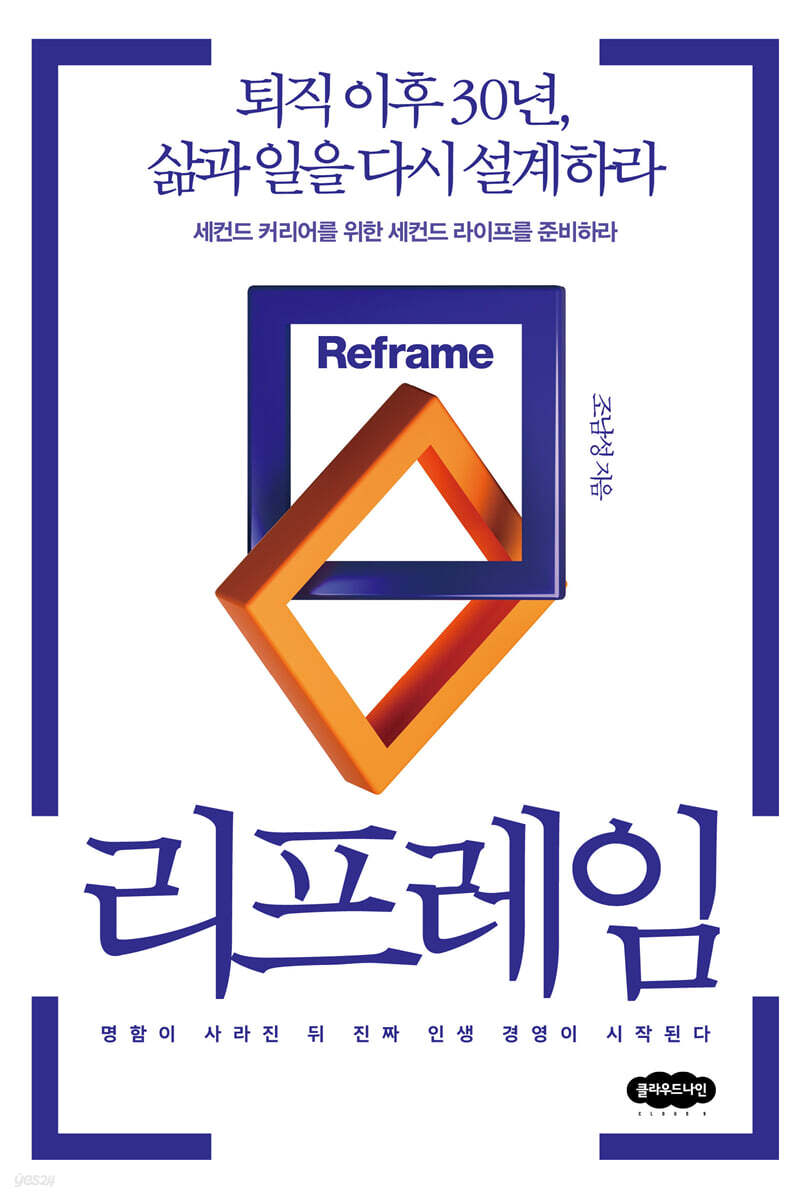
A book about life after retirement, written by the man who ran Samsung SDI (삼성SDI), is not the combination I expected to find in this week's new-release lists. Reframe (리프레임) by Cho Nam-sung (조남성) came out from Cloud Nine (클라우드나인) on 17 September 2026, and its premise is blunt: the thirty years after you hand in your badge are not leftover time. They are a second business to be run properly.
The short version, if you only have a minute
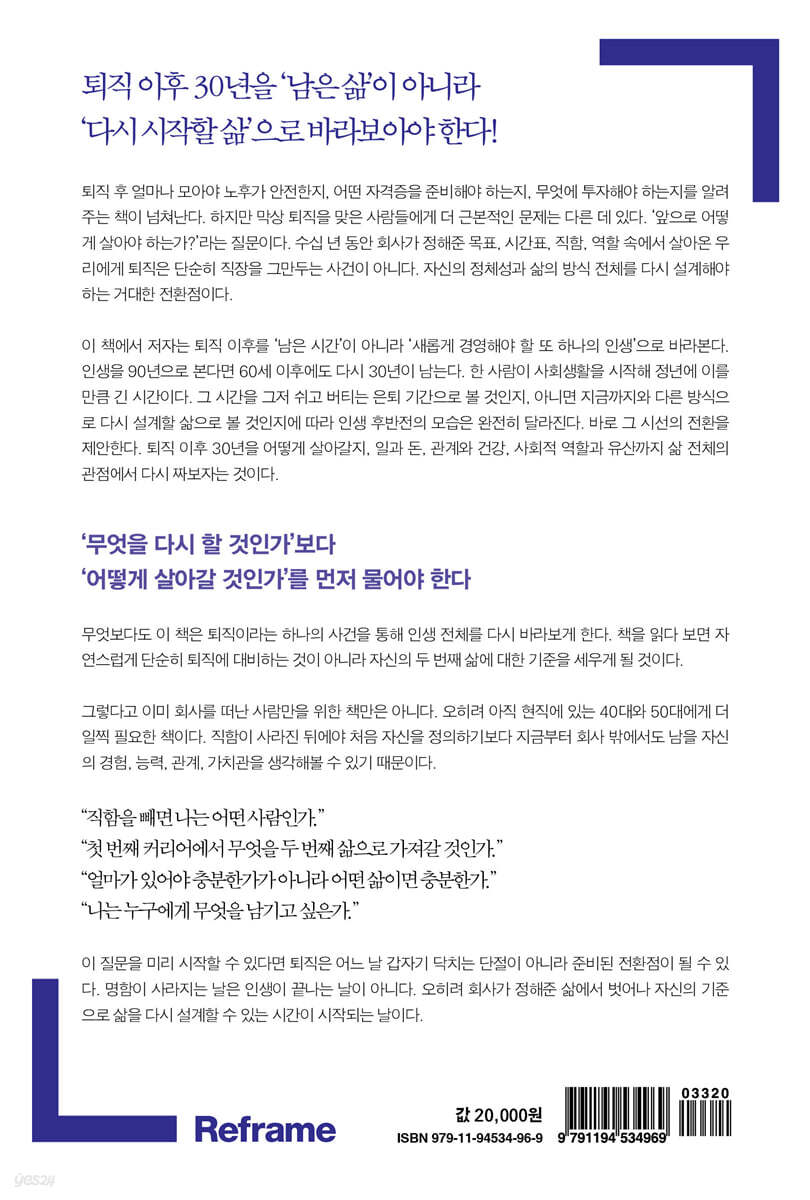
Cho argues that most retirement advice answers the wrong question. Books and seminars tell you how much you need saved, which certification to chase, where to put the money. His claim is that all of that is downstream of a question almost nobody asks first: how do I want to live? Only after that, he says, can you sensibly decide what to do, what to earn, and what to leave behind. The book is organised as a design manual for that sequence rather than a financial checklist, and it runs 236 pages in four parts, from "retirement is a platform, not a terminus" through to "don't die rich."
Why a retirement book from a semiconductor executive is not the usual thing
Credibility in this genre is usually borrowed. A financial planner writes about money, a counsellor writes about identity, and the reader has to assemble the two halves themselves. Cho's vantage point is different because he lived the discontinuity he writes about.
He joined Samsung Electronics (삼성전자) as a new hire in 1983 and finished his first career in 2017 as president and CEO of Samsung SDI. In between: head of Samsung's Japan sales subsidiary, memory marketing lead, head of the production technology institute, head of the storage business, head of the LED business, then CEO of Cheil Industries (제일모직) and Samsung SDI. He ran the sale of the HDD business and Cheil's chemicals arm, and turned around loss-making units in LED and polarising film. He holds the Industrial Service Merit Medal and the Silver Tower Order of Industrial Service Merit.
Then the title disappeared. By his own account he spent the period after stepping down travelling and meeting people, and concluded that "what will I do next?" was the wrong opening move. He retrained at the Korea Leadership Center as a professional coach and built a second career coaching executives at conglomerates, mid-sized firms and start-ups on strategy, organisational culture and leadership, later serving as a partner coach at a coaching firm and an adjunct professor at Sungkyunkwan University's college of information and communication.
That matters for how you read the book. When a man who once signed off on billion-dollar divestitures writes that the hardest thing about retirement was the expiry date on his own job title, it carries a weight that a generic "find your passion" chapter never does.
Retirement as a platform, not a terminus
The first part of the book is built on a single reframing: 퇴직은 종착역이 아니라 플랫폼이다 — retirement is a platform, not the last station. A terminus is where you get off. A platform is where you choose the next train.
What I found more interesting than the metaphor is the chapter that follows it, which Cho titles roughly "without a blueprint, your career becomes baggage." This is the opposite of the standard consolation. The usual message to a newly retired executive is that decades of experience are an asset waiting to be monetised. Cho's position is that unexamined experience is weight. Thirty years of knowing how a large organisation works is only valuable if you have a design for where it is meant to apply; without one, it mostly makes you rigid, expensive and difficult to place.
He pushes the same idea into the second-career chapters. One is titled "if you cannot invest another 10,000 hours" — an honest acknowledgement that the Gladwellian mastery timeline is simply not available to someone starting at 60. Another argues that "how well" beats "how hard," and a third states flatly that a career record is only an entry condition; the real weapon is attitude.
Cash flow beats net worth, and other unfashionable arithmetic
The third part turns to the machinery of the second life, and the chapter I would point to first is the one arguing that financial freedom comes from cash flow, not from assets.
This sounds obvious and is routinely ignored. In Korea, where a very large share of household wealth is locked in a single home, a retiree can look prosperous on a balance sheet while having almost nothing arriving each month. Cho treats that gap as the central financial problem of the second life rather than a footnote. The neighbouring chapters are similarly practical rather than aspirational: managing solitude inside a marriage's "third act," proving health with the body rather than with intentions, and treating work as a calling rather than a job description.
The fourth part is the one most books skip. It covers talking about death, closing out a personal profit-and-loss statement in the black, choosing whether to leave heirs a stepping stone or a bed to lie in, and a closing chapter titled "don't die rich." Whether or not you agree with him, it is unusual for a business-executive memoir to end there instead of on a victory lap.
What Korea's retirement-book wave is actually reacting to
Reading the new-release shelves for this blog three times a week, I have watched the second-life category go from occasional to crowded over the past year. It is worth saying plainly why, because it changes how you should read any individual title in it.
Korea became a super-aged society in December 2024, with more than a fifth of the population aged 65 or over, and it got there faster than any country has before. At the same time the practical retirement age at large Korean firms sits around 60 while the national pension does not begin paying for most people until 63 to 65, a gap of several years with no salary and no pension. Add a generation of managers who joined in the 1980s boom and are now exiting in bulk, and you have a very large, very anxious, very literate readership appearing all at once.
My honest read on the resulting publishing wave is that most of it is financial-product marketing wearing a cardigan. What distinguishes Reframe is that it refuses to open with a number. That refusal is either the book's greatest strength or, if you came looking for concrete tactics, its most frustrating feature. I do not think Cho fully escapes the limitation of his own vantage point either: advice built on the experience of a Samsung CEO who could retrain as an executive coach travels less well to a 58-year-old leaving a mid-sized supplier with no network above their old boss. The design framework survives that translation; the worked example does not.
Where this sits next to the other books I have covered
This is the third title in this general territory I have written about this month, and the three of them make more sense together than apart.
Earlier in September I covered 은퇴를 미리 살아봤습니다, a book about rehearsing retirement five years before the actual date, which is essentially the field experiment to Cho's blueprint: instead of designing on paper, the author simply lived a trial version of the second life while still employed. I would read that one alongside Reframe, because it supplies the empirical check that Cho's framework does not.
The other useful neighbour is N-Jobbing Done Right, an 18-year multi-career blueprint from Korea's N-job boom. That book approaches the same problem from below — building parallel income streams while young — where Cho approaches it from above, after the single big career has already ended. Between them you get both entry points into the same structural question.
And if the reader you have in mind is already past sixty, the practical companion is the Korean guide to using Gemini for ages 50 to 70+, which deals with the tooling side that Cho's book gestures at but never opens up.
The part that landed on me personally
My father retired from a manufacturing company at 59. For roughly the first eight months he kept getting up at 6:10 a.m., the same time he had woken for the commute, and he kept wearing a collared shirt to walk to the neighbourhood library. Nobody asked him to. When I finally asked why he did not sleep in, he said the alarm was not the point; the shirt was. He did not have a way to be a person without one.
I remember thinking at the time that this was sad. Reading Cho's first chapter, on the expiry date of a job title, I think I had it wrong. My father was not clinging to a costume. He was improvising a structure because nobody had ever told him he would need to design one, and he had about eight months of unplanned time to work it out on his own. He eventually did, through a woodworking class and, later, teaching that class. But the eight months were avoidable, and that is precisely the waste this book is written to prevent.
Book facts at a glance
- Title: Reframe (리프레임)
- Subtitle line on the cover: "Redesign your life and your work for the thirty years after retirement"
- Author: Cho Nam-sung (조남성), former president and CEO of Samsung SDI and Cheil Industries; executive coach
- Publisher: Cloud Nine (클라우드나인)
- Publication date: 17 September 2026
- Length: 236 pages
- List price: KRW 18,000
- ISBN-13: 9791194534969
- English edition: not confirmed. As of this writing there is no announced English translation, so the book is available in Korean only.
Who will get something out of this, and who will not
It fits you if you are five to ten years from leaving a long-held position and the thing keeping you up is not the pension number but the blank space after it. It fits you if you are already out and have noticed that the calendar, not the money, is the problem. It also fits adult children trying to understand a parent who has gone quiet since retiring.
It will not fit you if you want spreadsheets, annuity comparisons or a list of post-retirement qualifications ranked by pay. It also will not fit a reader who wants a step-by-step programme; this is a framework and a set of prompts, and the work of filling them in stays with you.

Questions readers keep asking about second-career books
Is this a finance book?
No, and it is fairly aggressive about not being one. Money appears in one chapter of the third part, framed around cash flow rather than accumulation. If you need retirement-income planning, this is a companion to that reading, not a substitute.
Do I need to be a Korean reader for this to be useful?
The framework is portable; the context is not always. Details like the corporate retirement age, the pension gap and the cultural weight of a business card are specifically Korean. Readers elsewhere will recognise the shape of the problem but should expect to translate the particulars.
How is this different from the flood of similar titles out this year?
Two things: the author actually made the transition he describes at the very top of Korean industry, and the book insists on sequencing the identity question ahead of the money question rather than the reverse. That ordering is the whole argument.
Is there an English edition?
Not that I can confirm. No English translation has been announced, so for now this is a Korean-language book. Anyone tracking it in English will have to work from the Korean edition or wait.
One last thought before I put this one down
I should be straight about what I have and have not done here. I have not read all 236 pages. What I have gone through carefully is the full table of contents, the publisher's material, the author's own account of why he wrote it, and the cover copy — and then I checked that account against what is publicly known about his career. So treat this as a considered look at what the book is trying to do and whether the person writing it has standing to do it, not as a verdict on every chapter.
What made me want to finish it is small. It is the chapter title "누구나 은퇴는 처음이다" — nobody has retired before. Obvious, and somehow never said. Everyone in that room is a first-timer, including the man who used to run a company of thousands. That is an unusually humble place for a book like this to start.
Book details and images sourced from the YES24 product page for 리프레임. No text from the book itself is reproduced here.
