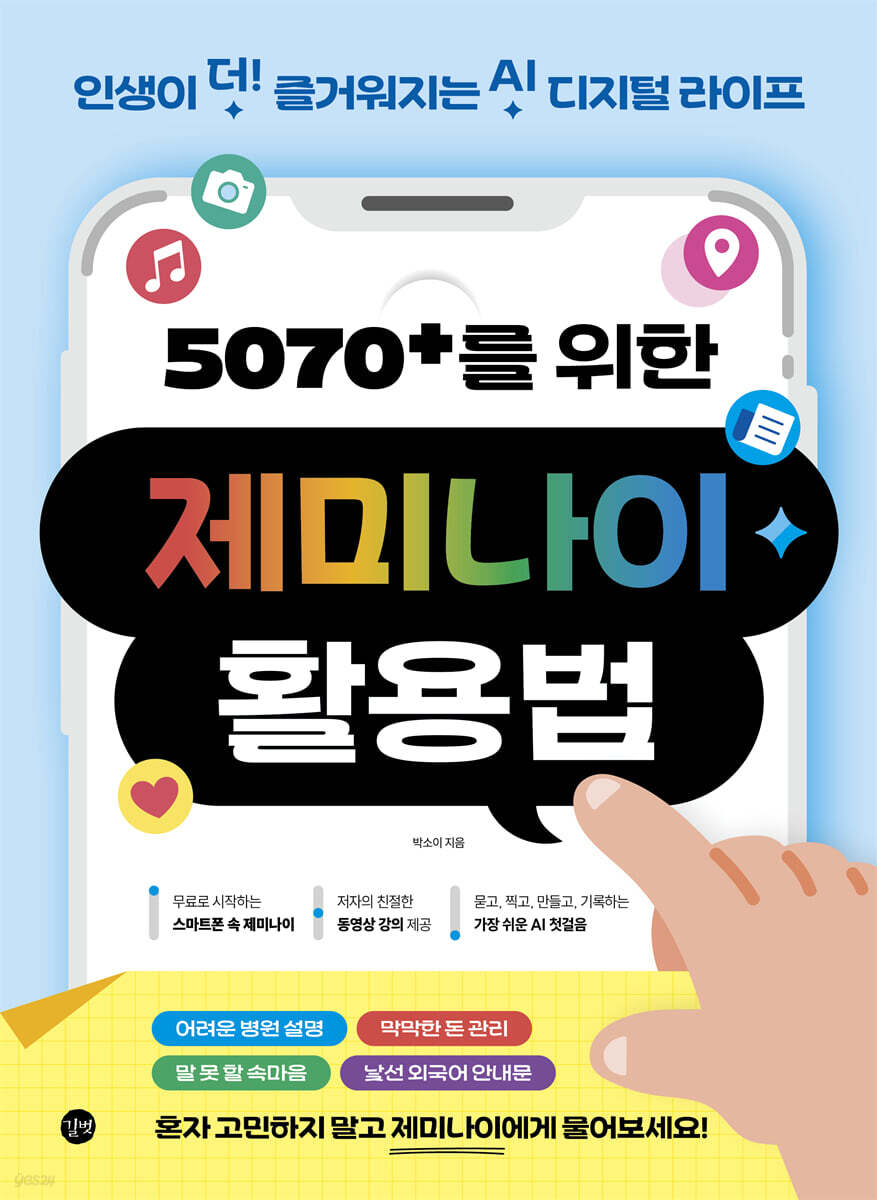
Short answer: Gemini for Ages 50 to 70+ (5070+를 위한 제미나이 활용법) by Park So-i (박소이), published by Gilbut (길벗) on September 14, 2026, is a beginner's guide that teaches readers in their fifties, sixties and seventies to use Google's Gemini app on the smartphone they already own. It is built around 42 hands-on exercises drawn from ordinary situations: decoding what a doctor just said, reading a foreign-language supplement label, comparing travel destinations, checking insurance premiums. No English edition has been announced, and the English title used here is my own working translation.
Why I stopped ignoring the "senior AI book" shelf
My mother is sixty-eight. She has had a smartphone for over a decade, pays her utility bills through a banking app, and once spent an afternoon teaching a neighbour how to use KakaoTalk video calls. She is not technologically helpless. And yet every time I mention that I use an AI assistant to draft or summarise something, the conversation ends in the same place: "That sounds like a young person's thing."
What finally made me pay attention to this book was not its marketing but a specific line in its table of contents: "Younger generations know the technology; seniors know life." That is not a compliment dressed up as a sales pitch. It is an argument about how these tools actually work, and it happens to be correct. A vague question produces a vague answer. A question loaded with context - your medication, your budget, your knee that has hurt since March - produces something usable. The people with the most context to supply are often the ones most convinced the tool is not for them.
The book in brief
- Title: Gemini for Ages 50 to 70+ (5070+를 위한 제미나이 활용법), subtitle: "An AI digital life that makes living more enjoyable"
- Author: Park So-i (박소이)
- Publisher: Gilbut (길벗)
- Publication date: September 14, 2026
- Length: 212 pages
- ISBN13: 9791140720569
- List price: KRW 17,820 (10% off the cover price on YES24 at the time of writing)
- English edition: none announced
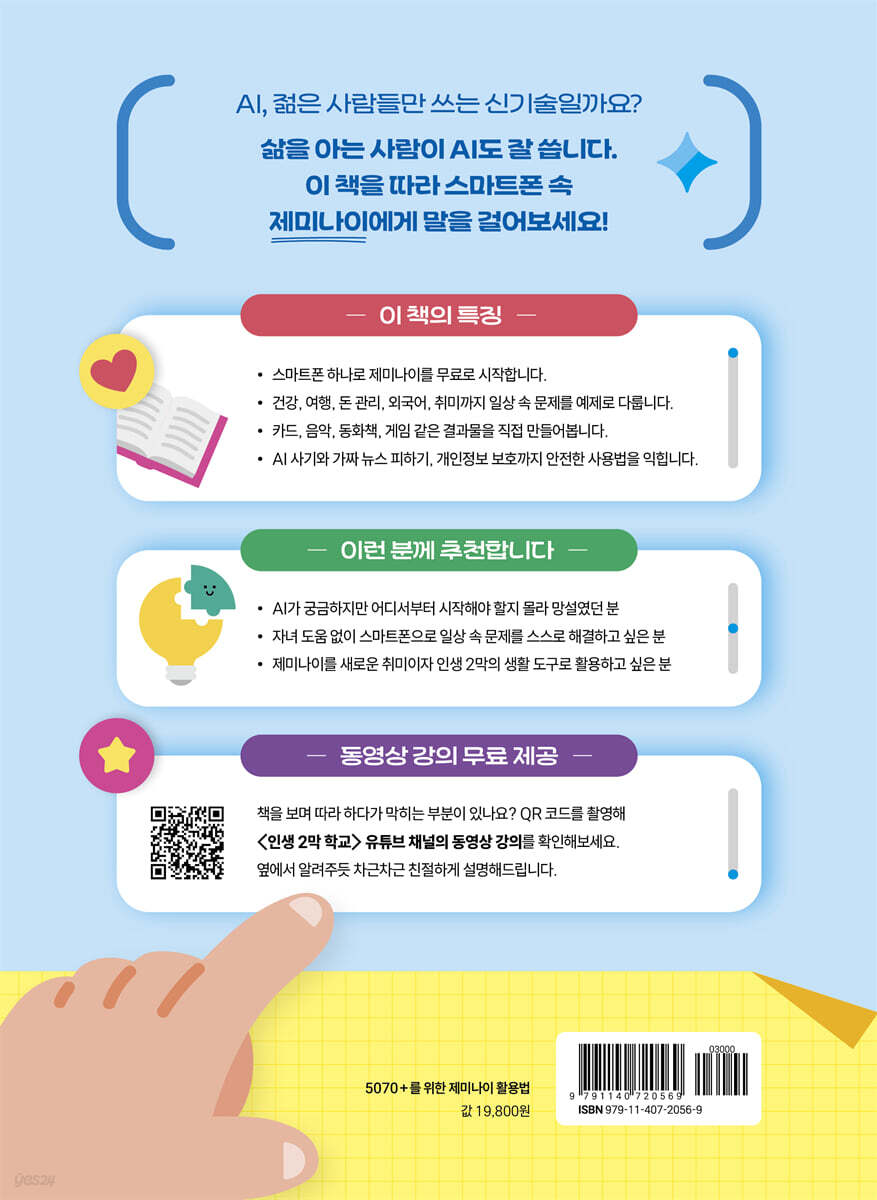
Park So-i works in HRD (human resource development) at a large IT company in Pangyo, Korea's tech corridor. By her own account in the author profile, she came back from parental leave to find the whole industry talking about nothing but AI, felt behind, and started a lunchtime study group with colleagues rather than waiting to catch up on her own. She has written two earlier AI-adjacent books, and she runs a YouTube channel called Second Act School (인생 2막 학교) where the exercises in this book are also demonstrated on video - a genuinely sensible design choice for a readership that may get stuck on step three of a ten-step walkthrough.
What problem is this book actually solving?
Korea crossed into super-aged-society territory at the end of 2024, when more than one in five residents passed the age of sixty-five. That statistic usually gets attached to stories about pensions and care work. It has a quieter consequence too: a very large group of people are now being asked to adopt a new category of software at exactly the stage of life when most people stop adopting new categories of software.
The book's answer is to refuse the usual framing. There is no chapter explaining what a large language model is, no diagram of a transformer, no glossary of AI vocabulary to memorise first. Chapter two is simply "check your Google account, install the app, understand the screen." Everything after that is a task someone actually wants done. The pedagogy is closer to a cooking class than a computing course.
Two chapters worth singling out
Chapter seven, on companionship. This is the section I expected to dislike. It covers talking to Gemini about personal worries, using it to "rediscover your own worth," and practising conversation with an AI coach. The reflexive criticism writes itself: an isolated older person substituting a chatbot for human contact is not a solution to loneliness. I still think that criticism is worth keeping in view. But the chapter is more modest than its headings suggest - it treats the tool as a place to put scattered thoughts in order, not as a replacement for a friend. Given that Korea's suicide rate among adults over sixty-five remains the highest in the OECD, I would rather see this subject handled carefully in a mainstream how-to book than left out of one entirely.
Chapter ten, on safety. The final chapter teaches three things: how to catch Gemini's plausible-sounding fabrications, how to protect personal information in a conversation, and how to turn off having your chats used for model training. Putting this last is a defensible choice - you cannot spot a hallucination before you have seen a few normal answers - but I would argue it earns a second read before chapter four. Chapter one already warns that scams and fake news are now AI-generated too. A reader who absorbs the enthusiasm of chapters four through nine and skips the caution at the end is precisely the reader this book should be protecting.
How it sits next to other AI books on this blog
I wrote about AI Agent, This Is How We Use It (AI 에이전트, 우리는 이렇게 씁니다) earlier this month, and the contrast is sharper than the shared "AI" label suggests. That book is written for office workers with deadlines and asks how much of a workflow can be delegated. This one assumes no workflow at all and asks a smaller, harder question: what would make you open the app a second time? Its unit of success is not hours saved but a card made for a grandchild, a trot song with your own name in it, a translated supplement label.
It also pairs unexpectedly well with Dementia or Depression? by Hideki Wada (치매인 줄 알았는데 우울증), which argues that much of what looks like cognitive decline in later life is withdrawal from stimulation and social contact. Read together, one book explains why staying curious matters and the other hands over a tool for it. Whether an AI assistant belongs in that role is genuinely arguable. That the argument is now being made in Korean, in a KRW 17,000 paperback aimed at people over fifty, is the part I find notable.

A note on the wider publishing trend
Tracking Korean new releases week after week for this blog, I have watched the AI shelf split into three distinct piles. There are developer manuals, which multiply fastest. There are white-collar productivity books, which peaked over the past year. And now there is a third pile - AI books that assume no professional motive at all, sold to readers whose reason for learning is simply that they do not want to be shut out. Titles aimed at the 5070+ bracket, at church volunteers, at people who mainly want to talk to their phone are appearing in the same month. Publishers have evidently concluded that the early-adopter market is saturated and the interesting growth is in reluctance. I think they are right, and I think that pile will be the one worth watching in 2027.
Who should pick this up
- Readers over fifty who own a smartphone, can install an app, and have been putting off AI out of vague intimidation rather than a specific objection
- Adult children who keep being asked the same questions by a parent and would rather hand over a book than repeat a demonstration
- Community centre, library and lifelong-learning instructors who need a ready-made curriculum of short practical exercises
- Anyone who wants Gemini specifically, on a phone, using mostly free features
Who should skip it: anyone already comfortable prompting an AI assistant daily, and anyone looking for comparisons across ChatGPT, Claude and Gemini. This book commits to one app and one device on purpose.
Questions readers might have
Do I need a paid Gemini subscription to follow the exercises?
No. The publisher states that most of the 42 exercises can be done with free features, and chapter two includes a plan comparison so you can decide whether upgrading is worth it for you.
Is there an English edition?
None has been announced. The book is written in Korean for a Korean readership, and the English title in this post is my own working translation.
Does it cover anything beyond asking questions?
Yes. Roughly a third of the book is about producing things - greeting cards, a personalised trot song, craft patterns, emoji, a simple memory game, a picture book - alongside camera translation and English practice.
Will it still be useful when Gemini's interface changes?
Partly. Screen-by-screen walkthroughs date quickly, which is the standing weakness of every app guide. The habits it teaches - supply context, check the answer, guard your data - outlast any particular button layout, and the author's YouTube channel is the obvious place to check for updated steps.
Is it suitable as a gift for a parent who is nervous about technology?
That is arguably its primary use case. The prerequisite is basic smartphone comfort, not curiosity about AI. If a parent can already use a banking or messaging app, they can start at chapter two.
Last thought
I have not read all 212 pages; what I have worked through is the table of contents, the publisher's material, and the author's own account of how this book came about. What stayed with me is that framing from chapter one - experience as the raw material of a good question. Most AI writing treats inexperience with technology as the deficit to be fixed. This one treats decades of ordinary life as the asset that makes the technology work better. I am going to test that claim on my mother this weekend, starting with the supplement label in her kitchen cupboard, and I suspect she will be faster at it than she expects.
Source for bibliographic details and cover images: YES24 product page.
