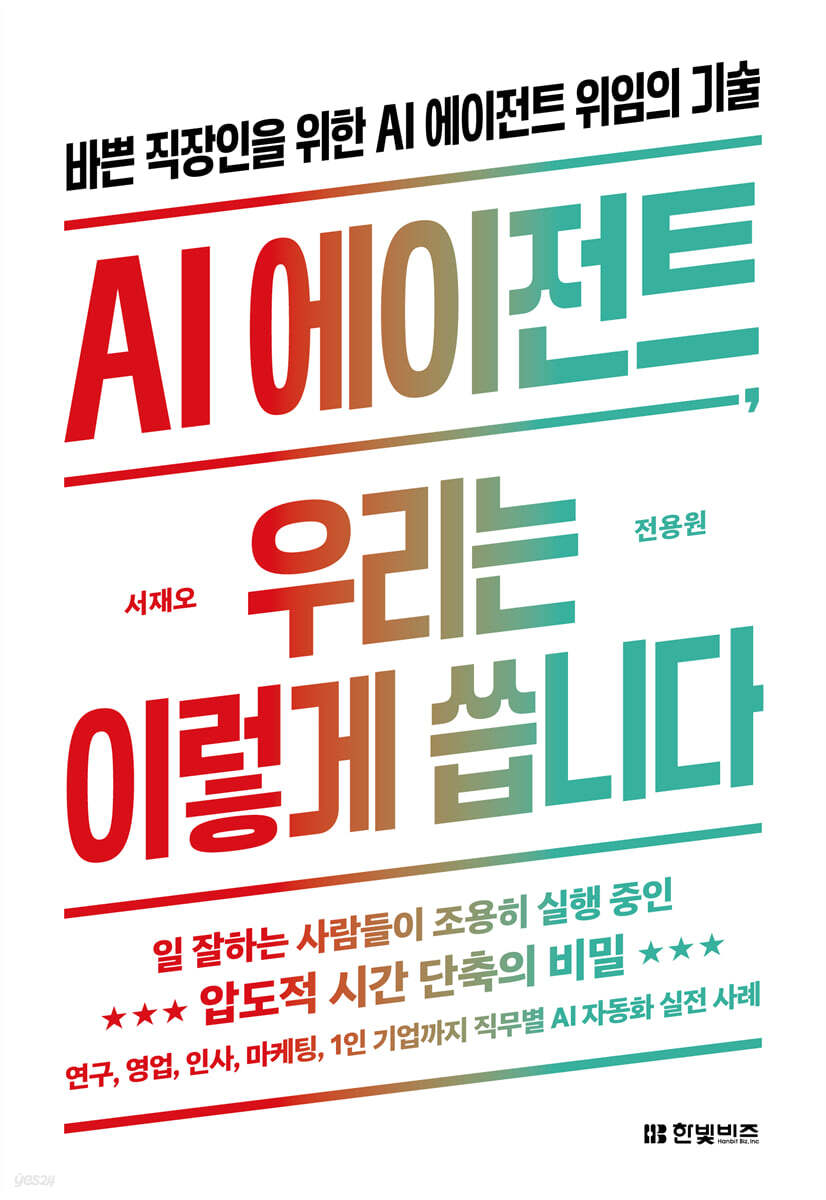
Key Answer: AI Agent, This Is How We Use It (AI 에이전트, 우리는 이렇게 씁니다) is a September 2026 Korean business book by content creator Seo Jae-o (서재오, pen name Riot/라이엇) and serial founder Jeon Yong-won (전용원), published by Hanbit Biz (한빛비즈). Rather than teaching prompt tricks, the book collects real workplace case studies of professionals across sales, marketing, HR, research, trading, consulting, teaching, and solo entrepreneurship who hand entire tasks to AI agents, not just single questions, and measure the result in hours of overtime avoided. As of this writing, no English-language edition has been announced, so the English title above is a working translation chosen for this review.
Book Information
- English Title (working translation): AI Agent, This Is How We Use It
- Korean Title: AI 에이전트, 우리는 이렇게 씁니다 (subtitle: 바쁜 직장인을 위한 AI 에이전트 위임의 기술, "The Art of Delegating to AI Agents for Busy Professionals")
- Authors: Seo Jae-o (서재오, pen name Riot/라이엇) and Jeon Yong-won (전용원)
- Publisher: Hanbit Biz Inc. (한빛비즈)
- Release Date: September 10, 2026
- ISBN13: 9791157848973
- Length: 288 pages
- Genre: Business / Management Strategy, AI & Productivity
- Source: YES24 product page

Why Is This Book Getting Attention Right Now?
South Korea's white-collar workplaces are famous internationally for long hours, and generative AI has already flooded Korean offices with chatbot subscriptions over the past two years. What has been missing, this book argues, is a shift from "asking AI a question" to "handing AI a job." Seo Jae-o and Jeon Yong-won frame that shift as the real dividing line among today's office workers: people who still copy and paste chatbot answers into their own documents, versus a smaller group who have started treating an AI agent as a junior employee who plans, executes, and reports back without step-by-step supervision. The book's central promise, that a reader can start a workday with half of it effectively finished by an AI "employee," is aimed squarely at Korea's overtime culture, and its case-study format is designed to make that promise concrete rather than aspirational.
Who Are the Authors, and Why Should Readers Trust Them?
Seo Jae-o, who writes under the pen name Riot (라이엇), has built a career translating frontier technology into plain language, working as a content creator and entrepreneur at the edge of the IT industry. He served as a virtual power plant (VPP) specialist at Korea's first machine-learning-driven renewable energy startup, currently runs decentralized services in the blockchain sector, and has spoken at technology and industry events in more than ten countries, including hosting Korea's first AI agent Web3 event. Jeon Yong-won brings an operator's perspective: an engineering student at Seoul National University who founded his first company at 21 and has since started three ventures, he co-founded DeepBrain AI (딥브레인AI) in 2016, where he worked on early deep-learning chatbot development and its adoption by enterprise clients. He now runs a startup where he applies AI agents to his own product development and daily operations while advising other companies on AI transformation (AX). Together, the pairing of a communicator with deep technical exposure and a founder who runs his own company on AI agents gives the book's advice a practitioner's credibility rather than a marketer's.
What Problem Does This Book Actually Solve?
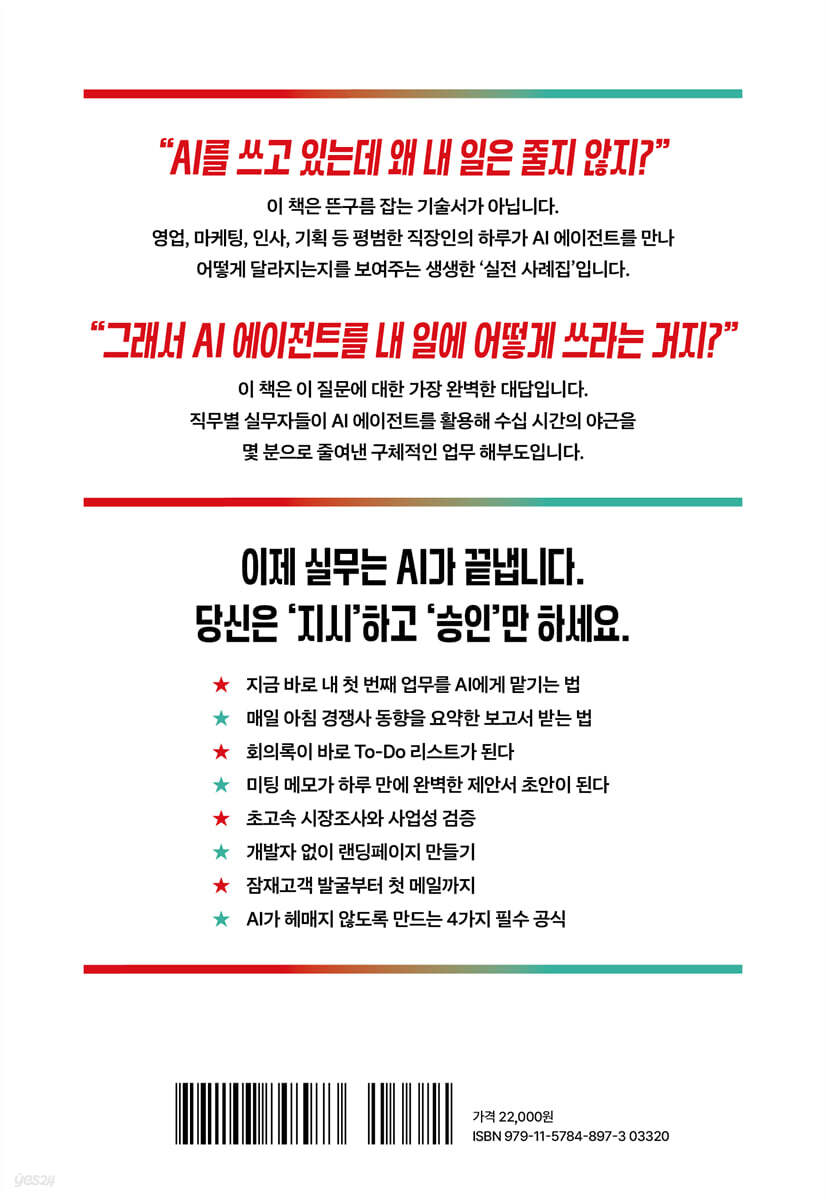
The book opens with what it calls a common misjudgment: assuming a general-purpose chatbot will simply "do it all" once installed. Its answer is a repeatable method rather than a single trick, built around what the authors call a "task anatomy map" (업무 해부도), a way of breaking one's own job into discrete, delegable pieces, and a "complete handoff formula" (완벽하게 일 떠넘기는 기술) for writing instructions specific enough that an AI agent can finish a task without the human re-checking every step. Two named AI agent platforms, referred to throughout the case studies by the nicknames Openclo (오픈클로) and Hermes (헤르메스), serve as the running examples, though the authors' larger argument is about the delegation method itself, one meant to transfer to whatever agent tools a reader already has access to.
What Makes This Book Stand Out from Other AI Productivity Books?
- Organizes its middle chapters strictly by job function, researchers and graduate students, traders, consultants, instructors, and planner-marketers, so readers can jump straight to a case study matching their own role instead of reading generic tips.
- Extends the argument from individuals to whole teams in Part 4, covering how AI agents change strategy planning, sales and marketing, operations, HR and onboarding, and even overseas community management.
- Devotes an entire section, Part 5, to solo entrepreneurs (1인 기업), showing how one person can use an AI "staff" to run market validation, landing pages, and cold outreach without hiring anyone.
- Closes with a chapter on turning saved time into revenue, not just efficiency, addressing a common criticism that AI productivity gains rarely show up on a company's bottom line.
- Includes a practical appendix on connecting the book's two example AI agents to Telegram, a concrete technical detail rather than only a conceptual overview.
- Written by one author who runs his own company using AI agents daily, giving the case studies an operator's rather than an observer's vantage point.
How Does This Fit Into Korea's Wider AI-at-Work Conversation?
For readers outside Korea, it helps to know that this book arrives alongside a broader publishing wave: Korean business publishers have released a run of 2027 trend-forecast titles this same season examining how AI reshapes work, several appearing in the same YES24 new-release list as this book. What distinguishes AI Agent, This Is How We Use It from that wave is its refusal to stay abstract. Where trend books describe where the economy is heading, this one is structured as a workbook of specific job-by-job examples, closer in spirit to a manual than a forecast. That distinction matters for an international audience trying to understand Korean workplace AI adoption: the demand here is not for more explanation of what AI agents are, but for reproducible playbooks that a specific employee, in a specific role, can adopt this week.
What Questions Should Readers Carry While Reading?
Because this book is built around imitation, applying its examples to a different job than the one described, these questions are meant to keep that transfer active rather than passive.
- Which of your weekly tasks are you still doing "prompt by prompt" instead of handing off as a complete job?
- What would a written, complete-handoff instruction for your most repetitive task actually look like?
- Where in your own workflow do you insist on checking every intermediate step, and is that caution actually necessary?
- If you ran a team, which case study in Part 4 maps most closely to a bottleneck your own department has?
- How would you measure whether time saved by an AI agent has turned into real output, rather than simply disappearing into more meetings?
Who Should Read This Book?
- Office workers in sales, marketing, HR, planning, or operations roles looking for role-specific AI delegation examples rather than generic chatbot tips.
- Solo entrepreneurs and freelancers (1인 기업) who want to run more of their business with AI support instead of hiring.
- Team leads and managers curious about how AI agents change department-level workflows, not just individual productivity.
- Researchers, graduate students, and consultants who need to compress research and proposal-writing timelines.
- International readers tracking how Korea's notoriously long-hours office culture is adapting to agentic AI tools.
Frequently Asked Questions
Is AI Agent, This Is How We Use It available in English?
As of this writing, no English-language edition of this book has been announced. The English title used in this review is a working translation, not an official published title, so readers should not assume a translated edition exists.
What is the book actually about?
It is a Korean business book that collects real case studies of professionals across roles such as sales, marketing, HR, research, trading, consulting, and solo entrepreneurship who delegate complete tasks to AI agents rather than only asking chatbots individual questions.
Do I need technical or coding experience to use this book's advice?
No. The book is aimed at general office workers, including a chapter for a non-developer instructor who built a quiz and assignment app, and frames its advice around instruction-writing and task delegation rather than programming.
Who are Seo Jae-o and Jeon Yong-won?
Seo Jae-o (pen name Riot/라이엇) is a technology content creator and entrepreneur with a background in renewable-energy machine learning and blockchain; Jeon Yong-won is a serial founder who co-founded DeepBrain AI in 2016 and currently runs a startup built around AI agents.
How long is the book, and when was it published?
The book runs 288 pages and was published by Hanbit Biz (한빛비즈) on September 10, 2026, under ISBN13 9791157848973.
What are "Openclo" and "Hermes" in this book?
Openclo (오픈클로) and Hermes (헤르메스) are the two AI agent platforms the authors use as running examples throughout the case studies; the book's broader delegation method is presented as transferable to other AI agent tools a reader may already use.
Is this book only useful for large-company employees?
No. Part 5 is dedicated specifically to solo entrepreneurs (1인 기업), covering market validation, landing page creation, and outreach without hiring additional staff, alongside the team-oriented chapters aimed at larger organizations.
Personal Thoughts
What stands out most about AI Agent, This Is How We Use It is how deliberately unglamorous its promise is. It does not claim AI will replace anyone's job outright; it claims, more modestly and more usefully, that a specific class of repetitive tasks, drafting, summarizing, chasing follow-ups, compiling reports, can be fully removed from a person's plate if the handoff instructions are written well enough. That is a lower bar than the sweeping AI-transformation language found in a lot of trend literature, and it is precisely why the book's job-by-job structure works: a reader in HR does not need to translate advice written for a trader, because the book already wrote a chapter for HR. For a market like Korea's, where long hours are treated as a structural problem rather than a personal failing, a book that treats AI delegation as a concrete counter-measure, rather than a buzzword, fills a real gap.
Final Note
AI Agent, This Is How We Use It captures a genuinely current moment in Korean office culture, the point where AI stops being a chatbot on the side and starts being treated as a coworker with defined responsibilities. Whether or not an English edition eventually follows, the underlying method, breaking a job into a task anatomy map and writing complete-handoff instructions, travels well beyond any one language or platform. For further details, pricing, and the full table of contents, see the original listing at YES24.
Book information and images referenced from YES24. This review is an original article written by the site operator based on publicly available book descriptions, not a translation of YES24's Korean-language copy.
