Say "four-two-nine" to most Koreans under forty and there is a decent chance they will hear "four-one-nine," the April 19 Revolution of 1960. The author of this book noticed exactly that confusion, and it is one of the reasons he wrote 536 pages about the other date: April 29, 1992, the day Los Angeles started to burn and Koreatown discovered that nobody was coming to help.
1992 LA Riots: Koreans on the Rooftops (1992년 LA 폭동, 지붕 위의 한인들, my translation of the title) by sociologist Jin Gu-seop (진구섭) came out from Pureun Yeoksa (푸른역사) at the end of September 2026. It is a narrative history of the five days Korean Americans call Sa-I-Gu, and of the thirty years of immigration that put Korean shopkeepers on the most dangerous street corners in the city in the first place. It is also, quite deliberately, an argument against two things the author thinks are happening to the memory of 1992: distortion in the United States and simple forgetting in Korea.
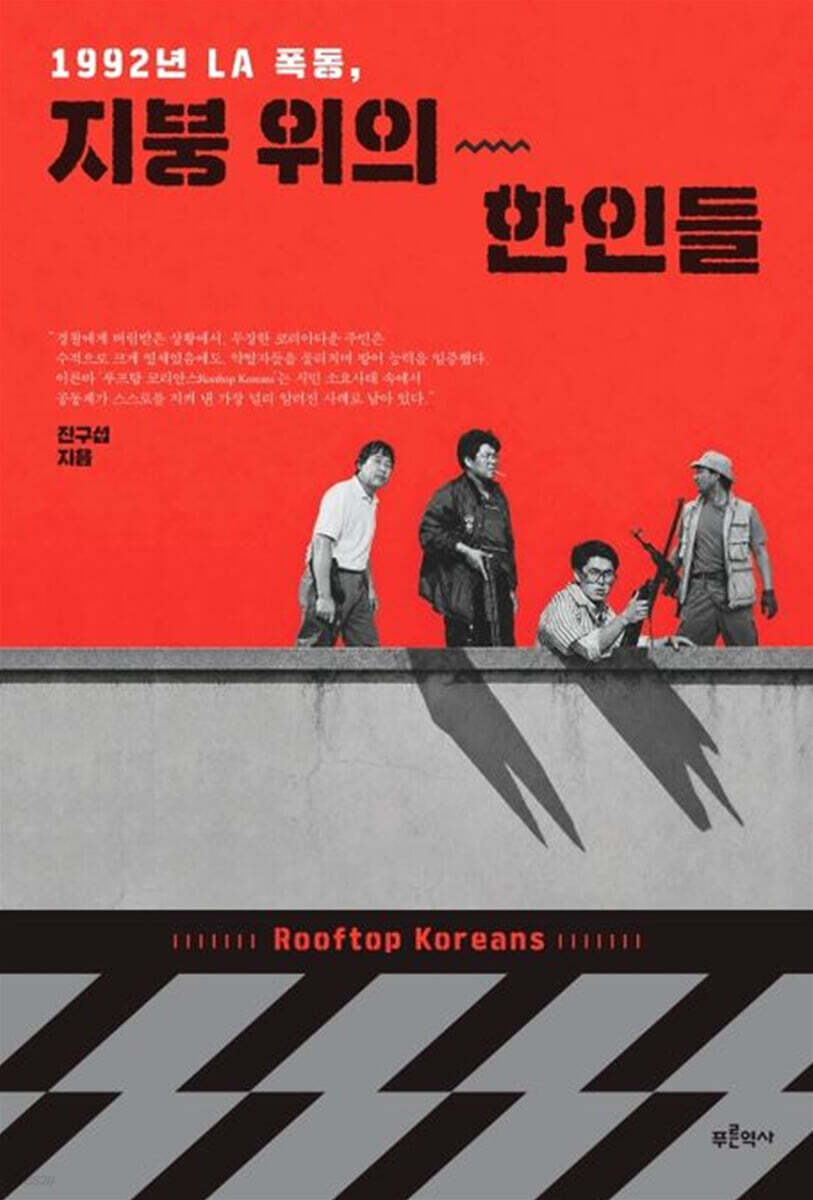
How is a 536-page book about five days actually organised?
The riot itself does not arrive until roughly page 250, almost halfway through, and that is the point. The book is laid out in eight parts, and the first three are about how Los Angeles was built to explode. Part one covers the 1965 immigration reform that reopened the door to Asian immigrants and the rise of Koreatown along Olympic Boulevard. Part two moves to South Central LA: gangs, drugs, crime, and the Korean merchant class that took over the liquor stores and corner markets nobody else wanted to run. Part three introduces Rodney King and an LAPD the author describes as soaked in racism.
Parts four and five are the two court cases that lit the fuse. The shooting of fifteen-year-old Latasha Harlins by store owner Soon Ja Du (두순자) in March 1991, and the trial that followed, get three full chapters. Then comes the Rodney King trial, where four officers filmed beating King were acquitted on April 29, 1992. Parts six and seven are the riot, reconstructed hour by hour and at times minute by minute: the police withdrawal from the first flashpoint, the looting of Korean stores in South Central, and the second day, when the trouble reached Koreatown and young Korean men climbed onto shop roofs with rifles. Part eight is the aftermath, from the shattered "American dream" to an ugly fight over how the relief money should be shared.
That structure tells you what kind of book this is. It is not a quick explainer. It is closer to a community history that happens to have a riot at its centre.
A sociologist who was 33 when Koreatown burned
Jin Gu-seop studied sociology at Korea University and worked as a journalist for KBS America (then KTE) before taking a PhD in race relations at the University of California, Irvine. He went on to hold positions at Johns Hopkins and the University of Michigan and has spent most of his career at McPherson College in Kansas; Yonhap's report on the book (6 October 2026) describes him as professor emeritus there. His previous Korean book, Who Is White? (누가 백인인가?, 2020, also Pureun Yeoksa), was a history of how American racial categories were invented and policed.
The biographical detail that matters most here is timing. Jin was a graduate student in Southern California in the spring of 1992, freshly out of journalism. This book is something he has been carrying for more than three decades, and the publisher says it took over four years of archival work to assemble. You can feel both halves of that history in the prose: the reporter's instinct for scene and dialogue, and the sociologist's insistence on structure.
Race riot or class war? The two-sided frame at the heart of the book
The most important argument in the book is about what 1992 actually was. Jin calls it both a race riot and a class conflict, and he refuses to let either half swallow the other. In his telling, the riot grew out of America's deep racial hierarchy and decades of accumulated economic inequality, with Korean immigrants wedged into the gap between a white establishment that had moved out of South Central and Black residents who had been left behind there.
The reason he presses this point is that, over time, a simpler story took hold in parts of the American media: that 1992 was essentially a fight between Korean shopkeepers and Black customers. Jin's view, as summarised by Yonhap, is that this framing quietly swaps a structural problem for an ethnic feud, and lets the police, city government and press off the hook. He is also blunt that neither the city of Los Angeles nor the LAPD has ever formally apologised to the Korean community for the absence of protection during those days.
I find this frame persuasive in outline. It is also the frame most likely to irritate readers from every direction, which is usually a sign that someone is trying to be honest about a complicated event.
How did a liquor store counter become a front line?
The chapters I found most illuminating are the economic ones, because they answer a question many Korean readers have probably never asked: why were so many Korean immigrants running shops in South Central in the first place?
Jin starts with wigs. In the mid-1960s, wigs were one of Korea's three biggest export products alongside textiles and plywood, and the book's figures are striking: Korean wigs went from around a quarter of the US import market in 1966 to well over 40 percent by 1970, and by 1972 Korea had overtaken Hong Kong as the largest wig exporter to the United States. Selling wigs into Black neighbourhoods showed early Korean immigrants that there was money to be made in areas large retailers would not touch. Rents were low, white owners were leaving, and so-called "heukin jangsa" (흑인 장사), business serving Black customers, became a standard path for new arrivals with limited English and some savings.
The book is unsentimental about what that path cost. Shopkeepers worked twelve to sixteen hours a day, took two or three days off a year, handled mostly cash and were frequent robbery targets. Jin describes the work as a living earned "with your life as collateral." He is just as direct about the other side of the counter: owners who wanted to be friendly but only had the English for transactions, small cultural misreadings that hardened into mutual distrust. That is not an excuse for anything that happened later. It is an explanation of why the anger, when it came, found Korean stores first.
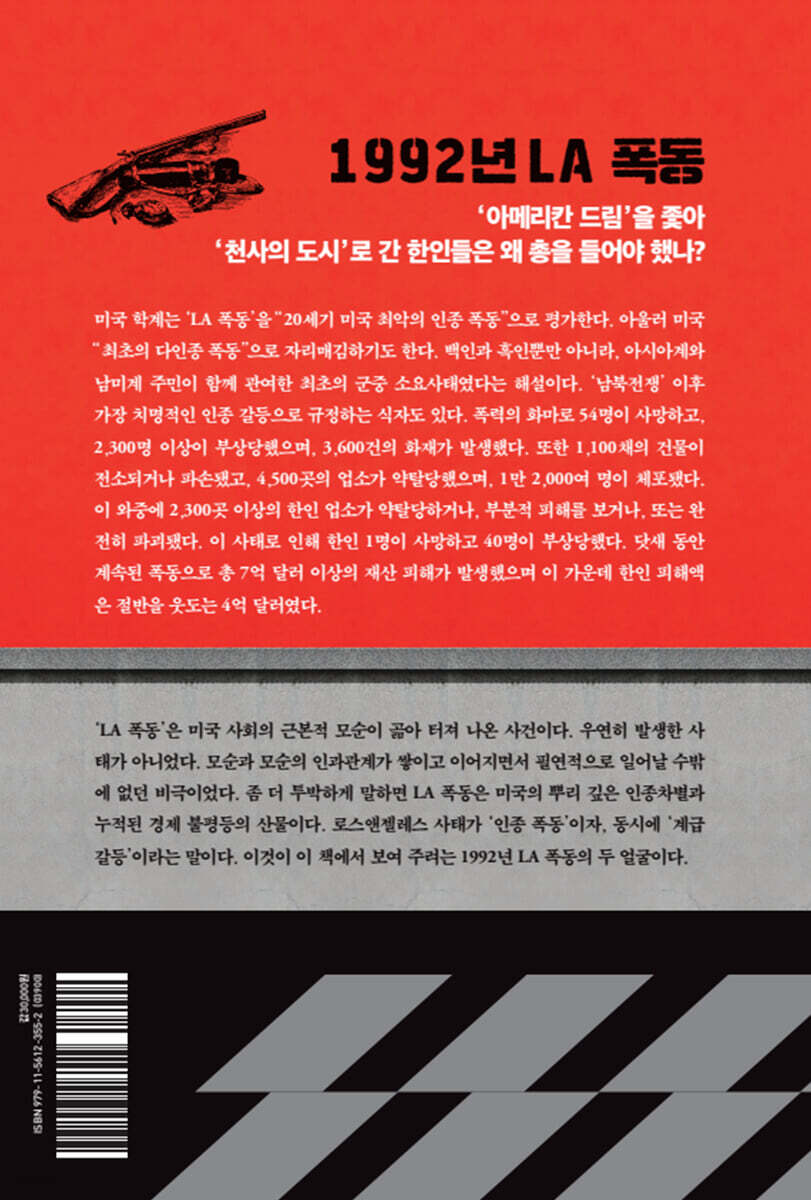
The rooftop photo has had a strange second life. Does the book rescue it?
Here is the part of the story I suspect many readers outside Korea already know, without knowing much else. The images of armed Korean Americans standing on Koreatown rooftops became, in the years since, a meme in American online culture under the label "Rooftop Koreans," usually shared with no context at all. The publisher's notes point out that the conservative Heritage Foundation has cited them as an example of Second Amendment self-defence when police are absent.
My own view, as someone who writes about Korean books for an English-language audience, is that this is exactly the kind of afterlife that makes a book like this necessary. A meme keeps the rifle and drops everything around it: the police commanders who, by the book's account, turned down requests to pre-position riot units because of overtime costs; the National Guard troops who reportedly arrived without ammunition; the sixteen-year-old who climbed onto his father's roof because the store was the family's only lifeline; and Edward Jae Song Lee (이재성), the eighteen-year-old killed by gunfire on April 30 while trying to help defend Koreatown. Jin restores all of that, which turns the image back from a slogan into a tragedy.
Whether readers who arrived via the meme will sit through 536 pages to get there is another question. I am not optimistic, and that is a comment on how history circulates now rather than a criticism of the book.
Where I have reservations: the Latasha Harlins chapters
Any Korean-language history of 1992 will be judged on how it handles the death of Latasha Harlins, and this is where I would read most carefully. The excerpts the publisher has released narrate the shooting partly from inside Soon Ja Du's fear, including her sense that one more blow would kill her. That is a legitimate thing for a historian to reconstruct, and the surveillance footage and trial record are well documented. But the facts are also stark: a fifteen-year-old girl was shot in the back of the head, a jury convicted Du of voluntary manslaughter, and the judge sentenced her to probation and community service rather than prison.
To the book's credit, its own chapter titles include the prosecutor's question of whether a Black girl's life was worth less than a dog's, and the final part mentions a 2016 meeting between the Harlins family and Korean community figures. So the other side is clearly present. I would still advise readers to take the narrative-nonfiction techniques here, the flashbacks and reconstructed dialogue, as interpretation layered on the record rather than as the record itself. That caution applies to every book written this way, not just this one.
Reading it next to a few books I have covered recently
This review sits naturally beside the book on the Russian warship Dmitrii Donskoi, which I wrote about in September. Both are Korean nonfiction about events that happened far from the Korean peninsula, and both are fundamentally about a story that got distorted over time: in Donskoi's case a billion-dollar gold myth, here a riot rewritten as an ethnic feud. The difference is that Jin's subject is still within living memory, and some of the people in his pages are alive to read it.
It also connects, in a less obvious way, to the oral-history timeline of Gireum-dong (길음동) I put together from twelve residents' testimony. That project taught me how quickly a neighbourhood's own memory thins out once the generation that lived it stops being asked. Koreatown in 1992 is the same problem on a larger scale, and Jin's opening line, that history is a history of memory, would have fit that post too. Finally, for a very different angle on Korea's relationship with the American market, Who Owns K-Pop? shows how far the terms of that relationship have shifted in thirty years: from immigrants selling wigs at a corner store to Korean companies negotiating global rights deals.

Who should spend 536 pages on this?
The obvious audience is Korean Americans, particularly second- and third-generation readers who grew up with Sa-I-Gu as a family story rather than a documented history; this may be the most detailed Korean-language account they can hand to their parents. Readers interested in US race relations will find a perspective that most English-language histories treat as a side note. Anyone in Korea who has only a vague sense that "something happened to Koreans in LA" will finish it with a much sharper picture.
Who might wait? Readers looking for a short overview, or for a primarily Black or Latino perspective on 1992, should start elsewhere and come to this as a complementary account. The page count and price are also real barriers, and I would rather say so than pretend otherwise.
The book at a glance
- Title: 1992 LA Riots: Koreans on the Rooftops (1992년 LA 폭동, 지붕 위의 한인들), English title is my own translation
- Author: Jin Gu-seop (진구섭)
- Publisher: Pureun Yeoksa (푸른역사)
- Published: 29 September 2026
- Length: 536 pages
- List price: KRW 30,000
- ISBN-13: 9791156123552
- English edition: not confirmed as of this writing
Questions readers have been asking
Why does the book call it a "riot" and not an uprising?
The author notes there is no official name for what happened on 29 April 1992; scholars variously call it a riot, disturbance, civil unrest, uprising or rebellion depending on how they read it. The book uses "1992 LA riots" or "4·29 riots" simply because those are the most widely recognised terms in Korean, and it says so explicitly.
Is there an English translation?
Not that I could find. As of early October 2026 I have not been able to confirm any English edition or announced translation, so for now this is a Korean-language book only.
How graphic is it?
It describes beatings, shootings and arson in specific detail, including the Rodney King beating and the death of Latasha Harlins. It is not sensationalist, but it does not look away either. Younger teenagers would probably need an adult reading alongside them.
Is there anything I should watch or read alongside it?
The 1993 documentary Sa-I-Gu, made by Dai Sil Kim-Gibson and centred on Korean women shop owners, is the classic companion piece and gives voice to the people Jin writes about. Reading the two together is a good way to check the book's narrative against first-hand testimony.
Where I am stopping for now
I should be clear about what this review is built on. I have not read all 536 pages. What I have worked through is the full table of contents, the publisher's long description, the excerpts released on YES24, the author's background, and Yonhap's report on the book. That is enough to judge its structure and its argument, but not to vouch for every reconstructed scene, and the Harlins chapters in particular are ones I want to read in full before saying anything stronger.
What I can say is that the book is asking the right question at the right time. Thirty-four years is long enough for a city to forget, short enough that the people who were on those roofs are still around to correct the record, and exactly the point at which a careful, slightly stubborn historian is most useful.
Book details, table of contents and excerpts referenced from the YES24 product page. Author background and summary of the book's argument also drawn from Yonhap News (6 October 2026). Written independently in this blog's own words.
