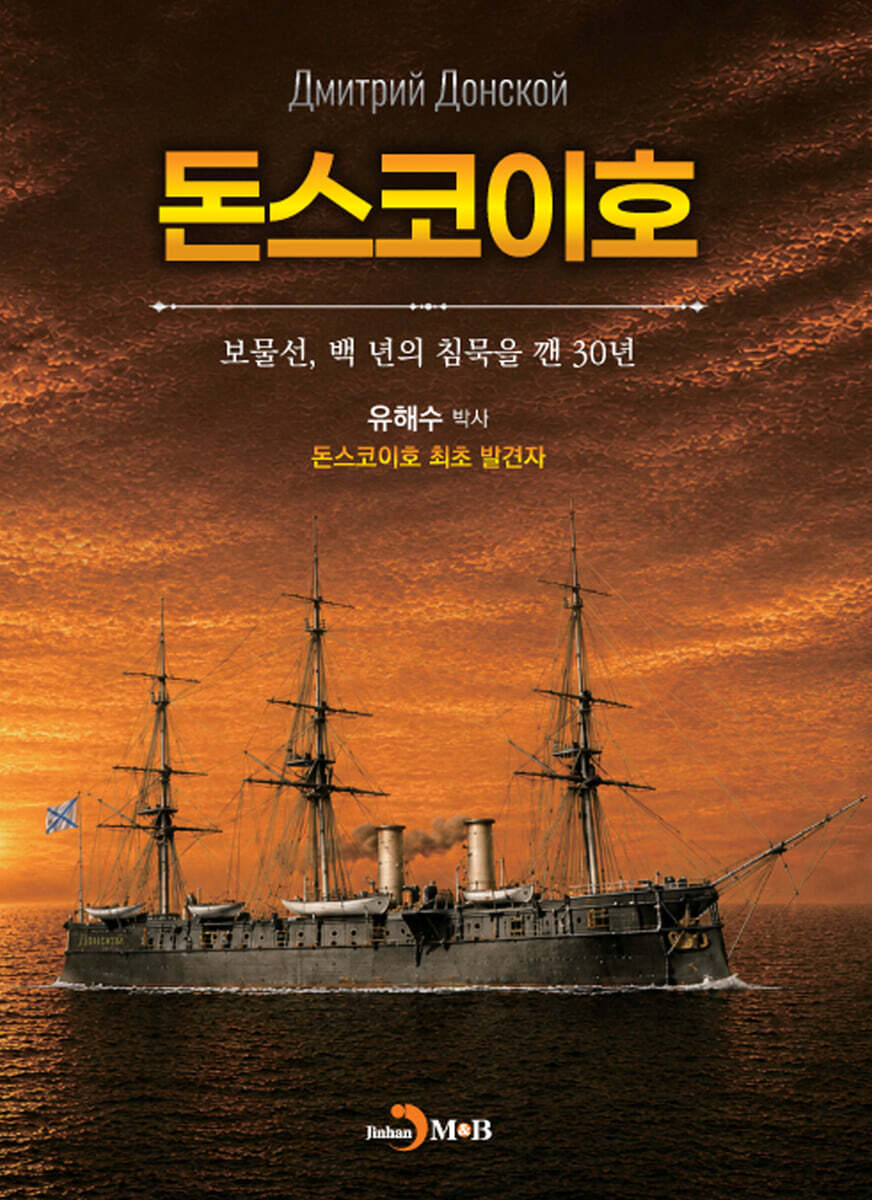
Dmitrii Donskoi (돈스코이호), published on September 11, 2026 by Jinhan M&B (진한엠앤비), is a 510-page nonfiction account of the Russian armored cruiser that was scuttled off Korea's Ulleungdo island in 1905 during the Battle of Tsushima. Its author, marine geologist Yoo Hae-soo (유해수), is the scientist credited with first locating the wreck in 2003, and the book takes direct aim at the myth that made this ship internationally famous: a rumored $130 billion in gold bullion that, according to its own back-cover message, was never the real story. This is a history of science, war, and memory told by the person who actually found the wreck, not a treasure-hunting narrative.
What Is Dmitrii Donskoi (돈스코이호) About?
The book's publisher describes it in a single, pointed line: "Dmitrii Donskoi is no longer a legendary treasure ship. It is a historical site that holds the final chapter of the Russo-Japanese War and the fate of the Korean peninsula." Structured across ten parts and more than 500 pages, the book moves from the ship's 19th-century origins and its final battle, through the decades of Korean deep-sea exploration that eventually located it, to the unresolved legal and economic questions around what to do with a century-old warship resting in Korean waters. The ten parts are titled (in translation): The Legendary Sea, The Truth About the Treasure Ship, The Soul of Armor, Where Joseon Korea Met Russia, The Whirlwind of the Russo-Japanese War, Heroes and Prisoners, Memories of the Deep, The Second Voyage, A Voyage Toward the Future, and an Epilogue. Yoo frames the ship not as a jackpot waiting to be raised, but as a rare, physical artifact of a war that reshaped Northeast Asia and Korea's own path toward colonization.
Who Is Yoo Hae-soo (유해수), the Scientist Behind the Discovery?
Yoo Hae-soo (유해수) is a marine geologist who earned his PhD in geophysics after studying resource engineering at Hanyang University (한양대학교). In 2003, he led the team that first identified the wreck of the Dmitrii Donskoi in the waters off Ulleungdo, a discovery later cited by South Korea's state-run Korea Institute of Ocean Science and Technology (KIOST), where Yoo went on to serve as director of the East Sea Research Institute. In 2016, the South Korean government awarded him the Dongtap Order of Industrial Service Merit (동탑산업훈장) for the discovery and his broader contributions to ocean development. He is now the CEO of Donskoi Media Inc., a company pursuing both the ship's eventual salvage and a planned film project, and he has previously written The Ulleungdo Treasure Ship Dmitrii Donskoi, Seabed Mineral Resources, Our Land, Dokdo, and a UNESCO manual on underwater cultural heritage. This professional background — a working ocean scientist rather than a treasure hunter or journalist — is central to how the publisher positions the book against the more sensational claims that have circulated about the ship since 2018.

Why Did a Russian Warship Sink Off a Korean Island in 1905?
The Dmitrii Donskoi was launched in Saint Petersburg in 1883 and spent much of its two-decade career as a commerce raider abroad before being folded into Russia's Second Pacific Squadron during the Russo-Japanese War of 1904–1905. That squadron, after an extraordinary seven-month voyage from the Baltic Sea, was intercepted and decisively defeated by the Japanese navy at the Battle of Tsushima on May 27–28, 1905 — one of the most lopsided naval battles in modern history, and the first in which wireless radio played a decisive role. According to English Wikipedia's account of the battle, the Donskoi survived the first day of fighting but was cornered by six Japanese cruisers the next day; of roughly 591 crew, around 60 were killed and 120 wounded before the captain anchored near Ulleungdo, sent the surviving crew ashore, and had the badly damaged ship scuttled rather than let it fall into Japanese hands. Japanese landing parties later took the stranded Russian sailors prisoner. For Korean readers, the wreck's location is not incidental: Ulleungdo sits in the East Sea near Dokdo, making the Donskoi part of a stretch of water that is central to Korea's own modern territorial and historical identity, not just a footnote to a European war fought at the far edge of the Russian Empire.
Is the Donskoi "Treasure Ship" Gold Legend Actually True?
No credible evidence has ever confirmed that the Dmitrii Donskoi was carrying gold when it sank, and the book's own author — the scientist who actually found the wreck — explicitly distances his work from that legend. The rumor exploded internationally in July 2018, when a separate South Korean company, Shinil Group (unrelated to Yoo or KIOST), announced it had located the wreck and claimed it held 5,500 boxes of gold bullion and 200 tons of gold coins worth an estimated $130 billion (about £101.3 billion). The claim triggered a wave of speculative investment and media coverage from outlets including the BBC, CNN, Forbes, and the Telegraph, but Shinil Group had not obtained Korean government salvage permits, offered no verifiable evidence of gold aboard the ship, and its representatives were later convicted and jailed in 2019 after prosecutors found the company had misled investors out of roughly 8.9 billion won. Maritime historians quoted by Smithsonian Magazine also pointed out basic logistical problems with the gold story: 19th-century Russia typically moved bullion by rail, not by warship, and the Donskoi's hold, already packed with 500 sailors, coal, and artillery, had little practical room for hundreds of tons of gold. Yoo Hae-soo's book, published years after that scandal by the scientist who made the original, credible 2003 discovery, reclaims the ship's story from that speculative bubble and reframes it as a case study in undersea archaeology, wartime memory, and Korea-Russia relations.
How Does the Book Connect This Story to Korea's Own History?
Two of the book's ten parts — "Where Joseon Korea Met Russia," with chapters on Emperor Gojong and the Donskoi, and the Korean Empire's relationship to the ship — place the wreck inside a longer arc of Korean-Russian contact rather than treating it as a purely foreign shipwreck. In the years before the Russo-Japanese War, Gojong's government leaned on Russia as a diplomatic counterweight to growing Japanese influence, most visibly when the king took refuge at the Russian legation in Seoul for about a year starting in 1896 (a period Korean historians call Agwan Pacheon, 아관파천). The Donskoi's fate in 1905, at the very end of that fragile Russian-Korean relationship, arrived just before Japan formalized its protectorate over Korea later that same year, making the ship's story a physical marker of the exact geopolitical hinge point after which Korea lost its independence for the following four decades. Framed this way, the book gives English-language readers unfamiliar with this period a concrete, almost cinematic entry point into a pivotal but often under-discussed stretch of Korean history.

Book Information
- Title: Dmitrii Donskoi (돈스코이호) — the ship's name is already the standard English form; this is not an invented translation
- Author: Yoo Hae-soo (유해수)
- Publisher: Jinhan M&B (진한엠앤비)
- Release Date: September 11, 2026
- Length: 510 pages
- ISBN13: 9791129065452
- Category: History > History & Culture Essays (역사와 문화 교양서)
- English Edition: Not confirmed as of publication; no English-language translation has been announced
Reading Checklist
- Note which claims in the book are drawn from Yoo's own 2003 discovery and research versus general historical background on the Russo-Japanese War.
- Track the timeline the book lays out for exploration attempts (1981–1998, 1999–2003, 2004–2013, 2014–2018, 2019–2025) and how the story of the search changes across those phases.
- Pay attention to how the book treats the 2018 gold-treasure controversy — as a case study in misinformation, rather than as evidence of hidden riches.
- Watch for the chapters connecting Gojong and the Korean Empire to the ship, and consider how this reframes the wreck as Korean history, not just Russian or Japanese history.
- Look for the appendices comparing Russian and Japanese fleet strength and the ship's proposed film and museum plans, which reveal how the author hopes this story will be used going forward.
Reading-Note Questions
- Why might a scientist who spent two decades searching for a shipwreck want to actively downplay its most famous, money-driven legend?
- What does the Donskoi's story suggest about how quickly a real historical discovery can be overtaken by financial speculation and media hype?
- How does knowing that the ship sank practically on Korea's doorstep, in the same year Japan moved to formalize its protectorate over Korea, change how you read this as "Russian" history versus "Korean" history?
- If the ship is ever raised, who do you think should have the strongest claim to it — Russia, South Korea, or some shared arrangement — and why?
Who Should Read This Book?
The publisher's own recommended-reader list, translated here, gives a good sense of the book's intended range: readers interested in deep-sea exploration and underwater technology; marine science and underwater archaeology researchers; readers trying to understand the Russo-Japanese War and Northeast Asian geopolitics; diplomatic and military historians; fans of "Titanic" or "Indiana Jones"-style discovery narratives, including those working in film, documentary, drama, or game development; music and performing-arts professionals interested in orchestral, choral, or screen-music content tied to the story; educators looking for interdisciplinary teaching material for young people; planners working on Korea-Russia cultural cooperation; and general readers with an interest in Korean history and international peacebuilding.
Frequently Asked Questions
Is there an English translation of Dmitrii Donskoi (돈스코이호)?
No English-language edition has been announced as of this book's September 2026 Korean release. The English name "Dmitrii Donskoi" used in this article refers to the ship itself, which already has an established English name from naval history, not a new translation invented for this post.
Who actually discovered the wreck of the Dmitrii Donskoi?
Marine geologist Yoo Hae-soo (유해수), the author of this book, is credited with first locating the wreck off Ulleungdo in 2003 while affiliated with South Korea's Korea Institute of Ocean Science and Technology (KIOST).
Is it true that the Dmitrii Donskoi was carrying $130 billion in gold?
That figure comes from a 2018 claim by Shinil Group, a company unrelated to the book's author, and it has never been substantiated. Shinil Group representatives were later convicted of misleading investors, and this book, written by the scientist behind the original credible discovery, explicitly separates its account from that gold legend.
What is the Dmitrii Donskoi's connection to the Battle of Tsushima?
The Dmitrii Donskoi was part of Russia's Second Pacific Squadron, which was destroyed by the Japanese navy at the Battle of Tsushima on May 27–28, 1905. Badly damaged on the battle's second day, the ship was deliberately scuttled off Ulleungdo to keep it out of Japanese hands.
Where is the wreck of the Dmitrii Donskoi located today?
The wreck lies roughly 1.6 kilometers off South Korea's Ulleungdo island, at a depth of around 400 meters, in the East Sea between the Korean peninsula and Japan.
What happened to the Dmitrii Donskoi's crew after the ship sank?
Most of the roughly 591 crew survived the battle itself, but around 60 were killed and 120 wounded. The captain sent the surviving crew ashore near Ulleungdo before scuttling the ship, and Japanese forces subsequently took the stranded sailors prisoner.
What other books has Yoo Hae-soo written about the Dmitrii Donskoi or Korean seas?
His earlier titles include The Ulleungdo Treasure Ship Dmitrii Donskoi, Seabed Mineral Resources, Our Land, Dokdo, and a UNESCO manual on underwater cultural heritage, reflecting a career spent researching Korea's surrounding seas rather than a one-off interest in this specific wreck.
A Final Note
What makes Dmitrii Donskoi stand out among new Korean nonfiction releases is how deliberately it works against the story's most viral version. Most people who have heard of this ship at all know it through the 2018 headlines about a $130 billion gold hoard — a story that turned out to be built on a fraudulent salvage scheme rather than verified history. Yoo Hae-soo spent two decades doing the slower, less lucrative work of actually finding the wreck and documenting its context, and this book reads as his attempt to reclaim that narrative on scientific and historical terms before the myth hardens further. For English-speaking readers curious about the Russo-Japanese War, Korea's turn-of-the-century diplomatic history, or simply how a genuine deep-sea discovery gets swallowed by speculation, it offers a rare firsthand account from the person who was actually there when the ship was found.
