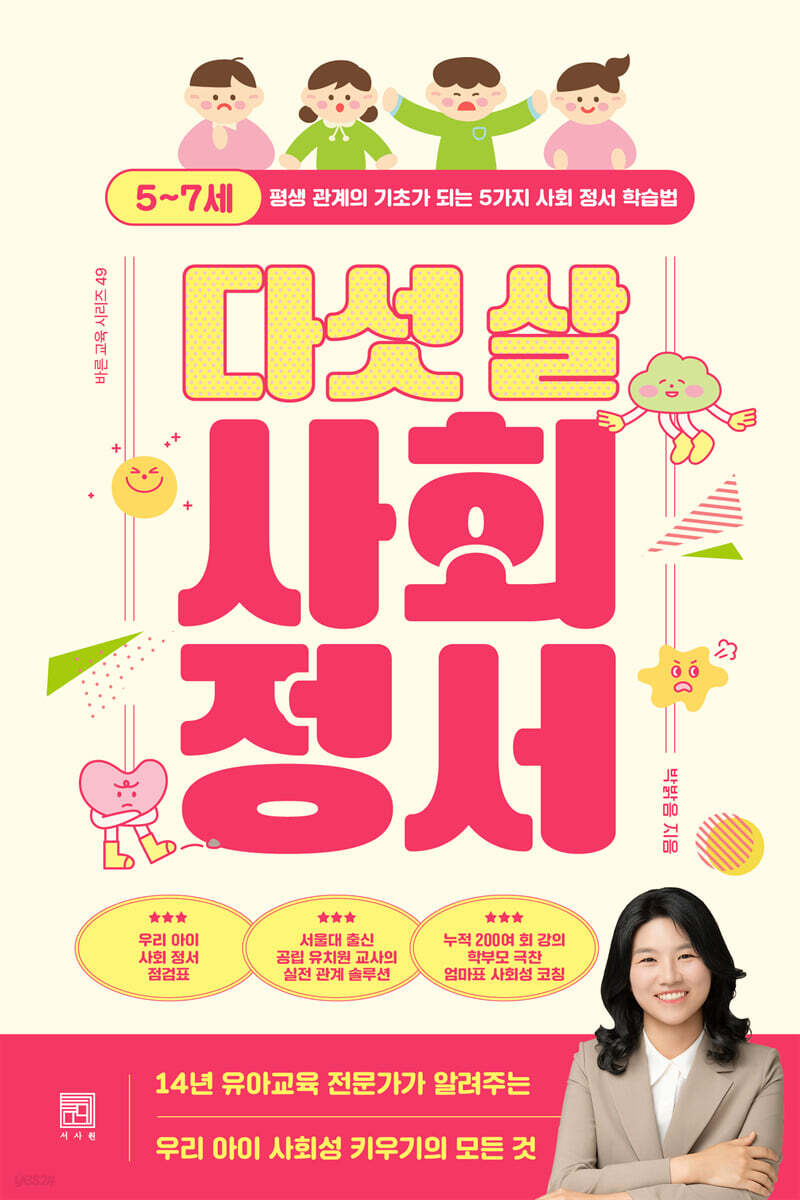
Key Answer: Social-emotional learning (SEL) for children ages 5 to 7 focuses on five core skills: self-awareness, self-management, social awareness, relationship skills, and responsible decision-making, and a new Korean parenting book, Five-Year-Old Social-Emotional Learning (다섯 살 사회 정서) by kindergarten teacher Park Balgeum (박밝음), shows parents how to coach these skills through everyday conflicts rather than formal lessons. The book arrives as South Korea's Ministry of Education has announced plans to expand SEL across the national curriculum starting in the 2026 school year, making the timing especially relevant for parents and educators alike.
What Is This Book About?
Around ages 5 to 7, a child's world expands beyond the family into the wider social world of peers. For the first time, kids face conflicts, negotiations, and disappointments that happen outside their parents' direct supervision — on the playground, at the kindergarten sandbox, during a board game with a cousin. Many parents find themselves at a loss beyond repeating "just get along with your friends," without any concrete idea of what to actually teach.
Five-Year-Old Social-Emotional Learning (다섯 살 사회 정서) is written by Park Balgeum (박밝음), a public kindergarten teacher in South Korea with 14 years of classroom experience, a graduate of Seoul National University's Department of Child and Family Studies (서울대학교 아동가족학과) and Korea National Open University's early childhood education program, and a master's degree holder (with doctoral coursework completed) in child and family studies from Kyungpook National University. She is also the author of the earlier bestseller Five-Year-Old Study Emotions (다섯 살 공부 정서), which focused on building learning readiness without early academics or private tutoring. The new book, published by Seosawon (서사원) and scheduled for release on September 21, 2026 (ISBN13 9791168226289, 220 pages), shifts focus from academic emotion to social emotion — how children learn to understand their own feelings, regulate them, read other people's feelings, and navigate relationships and decisions.
Why Does Social-Emotional Learning Matter So Much Right Now?
Social-emotional learning is not a Korea-only concept. Globally, the framework closely mirrors the five competencies defined by CASEL (the Collaborative for Academic, Social, and Emotional Learning), a US-based research organization that has shaped SEL curricula in schools worldwide since the 1990s: self-awareness, self-management, social awareness, relationship skills, and responsible decision-making. What makes this book's timing notable is a domestic policy shift — South Korea's Ministry of Education has stated that social-emotional learning will be woven into the national curriculum across all subjects starting in the 2026 school year, reflecting growing concern among Korean educators about rising peer-conflict incidents, school bullying reports, and children's emotional regulation difficulties in an increasingly academic-pressure-heavy environment. For readers outside Korea, this context matters: Korea's education system is famously intense and exam-driven from an early age, and a policy-level pivot toward emotional and social skills — rather than purely academic content — signals a meaningful shift in how the country is thinking about early childhood development.
How Does the Book Structure Its Advice?
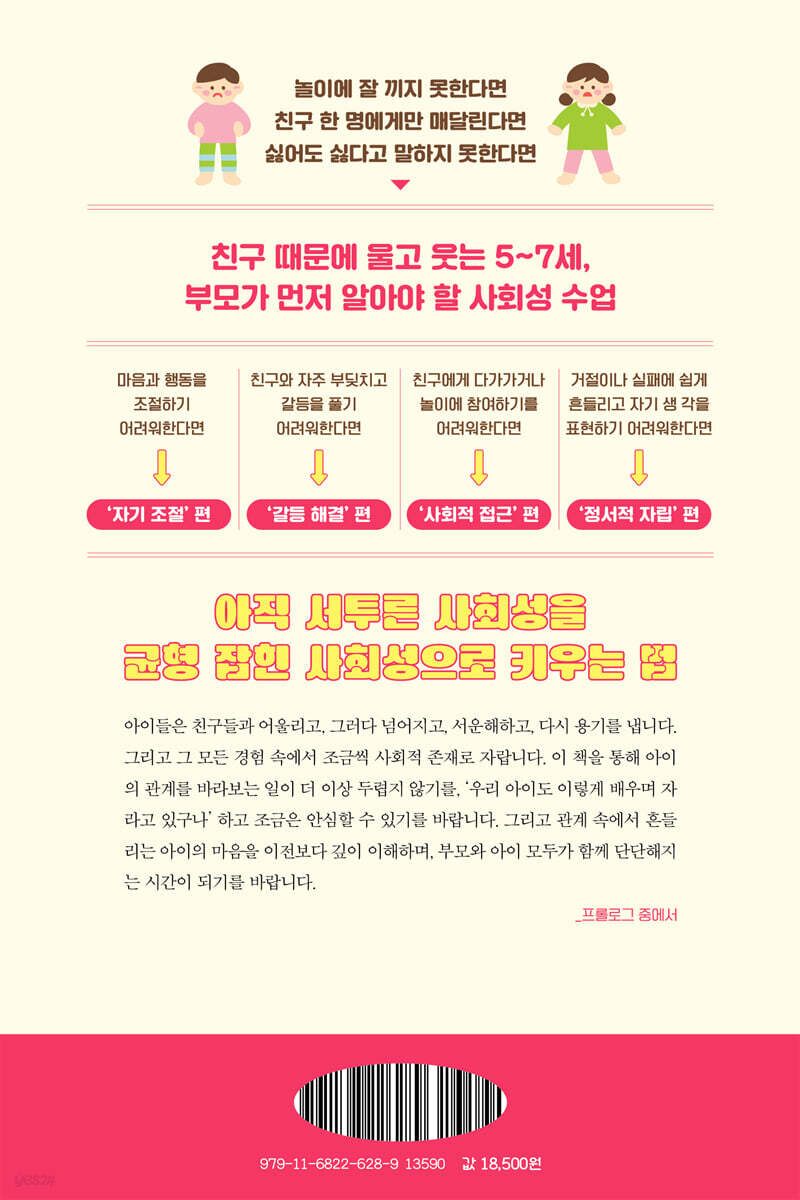
Rather than lecturing about theory, the book organizes its guidance around specific, recognizable child behaviors, grouped into four real-life situations:
- Situation 1 - The child who always wants their own way first (self-management): covers children who struggle to wait their turn, try to control their friends, take losing personally, dislike rules, and covet other children's belongings.
- Situation 2 - The child who frequently clashes with friends (conflict resolution): covers hitting before talking, crying instead of communicating, taking sides, lying out of fear of being scolded, and giving insincere apologies.
- Situation 3 - The child who hesitates at the threshold of relationships (social approach): covers children who can't join in play, cling to a single friend, can't tolerate rejection, can't say no, and are easily hurt by small comments.
- Situation 4 - The child who loses confidence when alone (emotional independence): covers children who can't do anything without a parent's permission, fear new environments, struggle with even small decisions, and absorb their parents' moods as their own.
Each scenario comes with two paired scripts: "Try not to say this" and "Try saying this instead," giving parents an immediately usable phrase rather than an abstract principle. A checklist at the start helps parents identify which of the five competencies their own child may need the most support in, and short "family social-skill games" are included at the end of each section to practice the concept through play rather than direct instruction.
What Kind of Language Does the Author Recommend Parents Use?
One of the book's most practical contributions is its emphasis on language. For example, when a child dictates every role in pretend play, the book suggests skipping "You can't just decide everything" in favor of "Let's ask your friends what roles they'd like to play" — a small shift from correction to open-ended inquiry. When two children want to play different games, instead of resolving the standoff for them with "You give in this time," the author models asking, "You want to play dinosaurs and your friend wants to play store. How can we figure out a way for both of you to have fun?" This reframes the parent's job from referee to facilitator, and treats compromise as a skill to be practiced rather than an outcome to be imposed.
The book also devotes attention to lying, arguing that a young child's dishonesty is rarely a deliberate ploy for gain (as it can be in adults); more often it stems from fear of disappointing a parent or an inability to separate "I made a mistake" from "I am a bad person" at this developmental stage. The suggested approach favors gently separating the child's identity from the mistake so honesty feels safer than concealment.
Who Should Read This Book?
- Parents of children roughly ages 4 to 8 who are entering kindergarten or early elementary school and beginning to form independent peer relationships.
- Parents whose children have had recurring friction with friends — hitting, crying, excluding others, or refusing to share — and want scripts rather than vague advice.
- Early childhood educators and kindergarten or daycare teachers looking for classroom-transferable language for social conflict moments.
- Readers interested in how Korea's 2026 curriculum reform toward social-emotional learning is being translated into practical, at-home guidance.
Reading Checklist Before You Start
- Think of one recent conflict your child had with a friend or sibling. Which of the five SEL competencies (self-awareness, self-management, social awareness, relationship skills, responsible decision-making) was most tested in that moment?
- Notice your own default script when your child clashes with a friend — do you tend to hand down a verdict, or ask questions first?
- Keep a note of any phrase from the book's "try saying this instead" lists that you actually use during the week you read it.
- Consider whether your child's temperament (cautious/slow-to-warm vs. bold/impulsive) changes which chapters are most relevant.
Reading-Note Questions
- Does the book's four-situation framework match the specific friction points you've observed in your own child, or does your child's pattern fall outside these categories?
- How does the author's advice to treat a young child's lying as fear-driven rather than manipulative change how you might respond next time?
- What would it look like to shift from "solving" your child's friendship conflicts to "facilitating" a resolution, as the book recommends?
- How much of the book's approach depends on a Korean kindergarten/daycare context, and how much translates directly to homes, playgrounds, or schools elsewhere?

Frequently Asked Questions
What age range is this book written for?
The book is aimed primarily at parents of children ages 5 to 7, though the author and publisher note the guidance is broadly useful from about age 4 through early elementary school, since peer social dynamics extend well past kindergarten.
Is Five-Year-Old Social-Emotional Learning available in English?
As of this writing, no English-language edition of 다섯 살 사회 정서 has been announced. The English title used in this review, "Five-Year-Old Social-Emotional Learning," is a working translation for descriptive purposes, not an official published title.
What are the five core skills of social-emotional learning discussed in the book?
The book organizes its advice around self-awareness, self-management, social awareness, relationship skills, and responsible decision-making — the same five-competency framework used internationally by SEL researchers such as CASEL.
Is this the author's first parenting book?
No. Park Balgeum previously published Five-Year-Old Study Emotions (다섯 살 공부 정서), a bestseller focused on building children's learning readiness and academic emotional resilience without relying on early tutoring or accelerated study. The new book shifts the same practical, teacher's-eye approach toward social relationships instead of academics.
Why is South Korea expanding social-emotional learning in its national curriculum in 2026?
South Korea's Ministry of Education has cited rising concerns about school bullying, peer-conflict incidents, and children's emotional regulation as reasons for weaving SEL more deliberately across the curriculum starting in the 2026 school year, reflecting a broader policy pivot beyond purely academic performance.
Does the book require any special program or curriculum to use at home?
No. The book is designed for ordinary daily use — its scripts, checklists, and short "family social-skill games" require no materials beyond the book itself and can be applied to everyday situations as they naturally arise.
How is this book different from general parenting advice books?
Rather than offering broad philosophy, it organizes advice by specific, recognizable child behaviors (for example, "the child who hits before talking" or "the child who can't say no") and pairs each one with a concrete phrase to avoid and a phrase to try instead, drawn from the author's 14 years of direct classroom experience and her own parenting of two children.
Personal Thoughts
What stands out about this book is its restraint. Rather than promising to produce a permanently well-adjusted, conflict-free child, it treats friction — hitting, crying, excluding, lying — as ordinary developmental noise to be worked through with better language, not eliminated through better discipline. That framing may be reassuring for parents who worry that a single playground meltdown reflects some deeper failure. The book's grounding in a working kindergarten teacher's day-to-day observations, rather than purely academic theory, is also likely to appeal to readers who want field-tested phrasing over abstract parenting philosophy.
For readers outside Korea, the book offers a useful window into how a notably exam-focused, achievement-driven education culture is now placing new institutional weight on emotional and social skills — a shift worth watching as more countries reconsider what early education should prioritize.
Note: The English edition's availability has not been confirmed, and the title translation above is unofficial. This review is an original summary and analysis based on the publisher's official book description and product listing, not a translation of the Korean-language source material.
Source: YES24 product page for 다섯 살 사회 정서 (Five-Year-Old Social-Emotional Learning)
