Here is the whole argument of this book compressed into one table. Kim Dae-soo (김대수), a KAIST neuroscientist who says openly that he has ADHD, thinks the question "How good is your concentration?" is the wrong one. He wants you to ask four different questions instead, and each one has two possible answers.
| The question the book asks | One pole | The other pole |
|---|---|---|
| What does my brain focus on? | Generalist, G (팔방미인파) | Specialist, S (한우물파) |
| Who steers my attention? | Sailboat, B (돛단배파) | Motorboat, T (모터보트파) |
| How do I focus? | Facts, F (팩트파) | Context, C (맥락파) |
| What do I focus for? | My own star, M (내별파) | Our shared star, U (우리별파) |
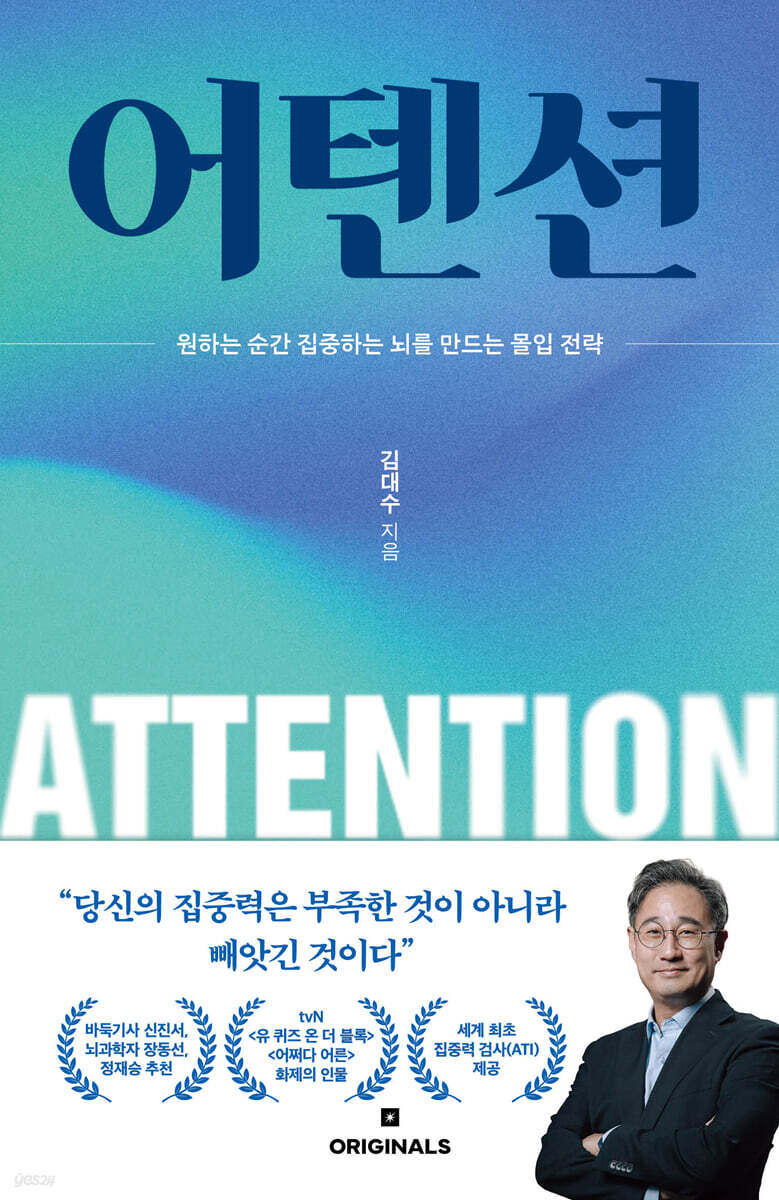
Cross the four axes and you get sixteen "attention types." The book, Attention (어텐션), published by Originals (오리지널스) on 30 September 2026, includes a self-assessment the author calls the ATI, or Attention Type Index, so readers can find their own four-letter code. If that sounds a lot like MBTI, you are not imagining it, and I will come back to that. But the more interesting thing about the book is not the test. It is the claim underneath it: that Korea has spent decades treating one particular style of attention, sitting still for a long time on one thing, as if it were the only kind that counts.
Why are Korean bookshops suddenly full of books about focus?
Spend ten minutes on the science and self-help shelves this autumn and you will notice a pattern. On the day Attention appeared, the Korean outlet Brain Media ran it in its book column alongside a cluster of related titles: one telling readers their concentration is "not at fault," another asking what ADHD actually is, another on dopamine-based study methods, another on getting to know yourself through brain science. That is not a coincidence of release schedules. It is a market responding to a real anxiety.
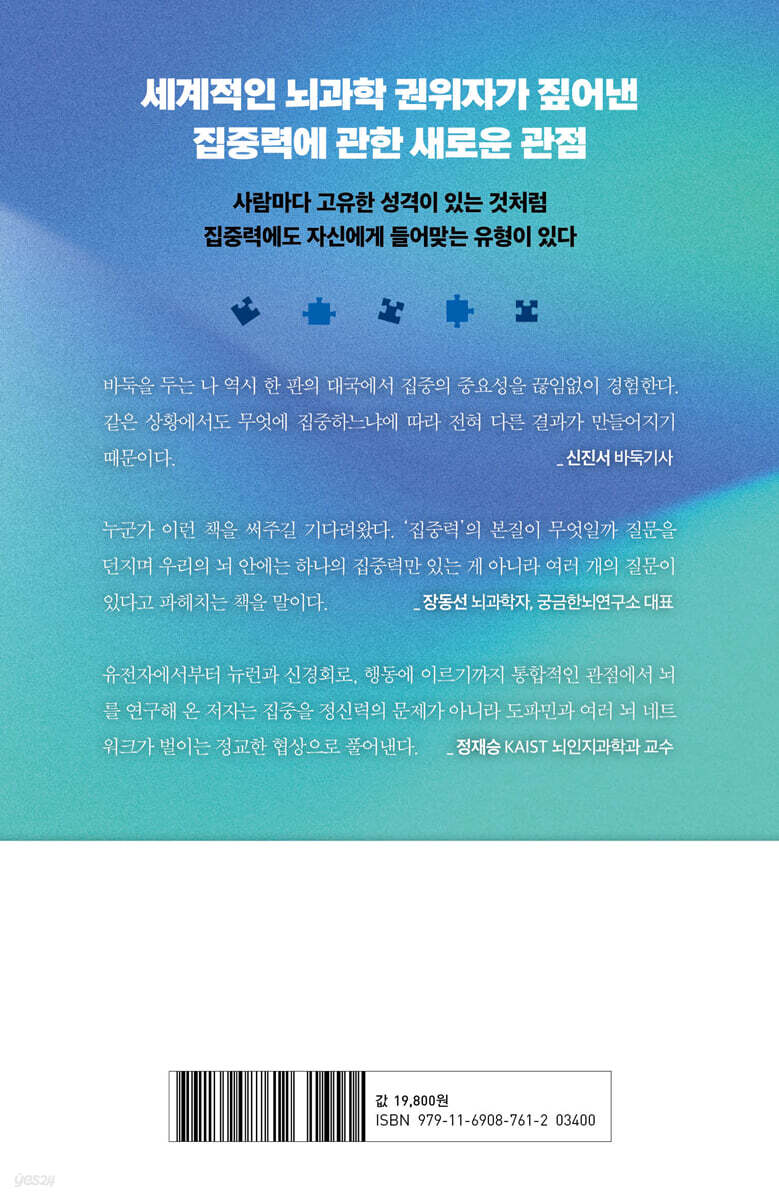
Two forces seem to be feeding it. The first is the phone. "Short-form video destroyed my attention span" has become a kind of national confession, repeated by students and office workers alike. The second is the rise of adult ADHD as a topic people talk about publicly, sometimes as a diagnosis and sometimes as a vague self-description. One of the book's endorsers, the neuroscientist Jang Dong-seon (장동선), points to a telling detail in his blurb: more and more people who do not have ADHD now want the medication anyway, and he credits Kim for locating the cause in how society defines concentration rather than in individual weakness.
My own reading of the trend is a little more cynical. Most books in this wave sell a fix: seven habits, a dopamine detox, a morning routine. What makes Kim's book stand out, at least on paper, is that it starts by questioning the target. Before you try to raise your concentration, he asks, whose standard are you trying to meet? The first part of the book is literally titled "For whom are we raising our concentration?" (누구를 위하여 집중력을 올리나). That is a better first question than most of the genre manages.
Who is Kim Dae-soo, and why does his own diagnosis matter?
Kim is a professor at KAIST (YES24 lists him in the Department of Biological Sciences) who works in behavioural genetics, the field that asks how genes shape behaviour, and in the neural circuits behind instinctive behaviour. He has published in Nature, Science and Neuron, won KAIST's teaching award three times in a row, and founded and runs a brain-disease company, HLB Neurotobe. Korean television audiences may know him from tvN's lecture show Adulting (어쩌다 어른) and from You Quiz on the Block (유 퀴즈 온 더 블럭).
The detail that changes how you read the book, though, is personal. Kim describes himself as someone who was told for years that he was "scattered" and "couldn't concentrate," and according to Jang Dong-seon's endorsement he writes frankly about his ADHD diagnosis and about taking medication. Jeong Jae-seung (정재승), another well-known KAIST brain scientist, puts it nicely in his own blurb: a researcher who spent his career looking at other brains through a microscope has, this time, put himself on the slide.
That matters because it gives the book a stake. When a neuroscientist without ADHD tells readers that distractibility is "just a different style," it can sound like a pat on the head. When a scientist with a long publication record says his scattered, curious brain is the same brain that built that career, the argument has some weight behind it. One excerpt released by the publisher states it plainly: just as he has lived with a form of attention adapted to his own ADHD, other people find work that suits their own attention patterns, and the brain is designed less to focus on whatever it is given than to go and find the things it can focus on.
What are the three "lamps" of attention in the brain?
Before the typology, the book spends its second part on the neuroscience, and this is the section I would point most readers to, because it reframes the problem in a useful way. Kim describes attention as a negotiation between three systems rather than a single muscle.
Automatic attention (자동집중) is the lamp that instinct switches on: your head turning at a car horn, the smell of something burning, a parent waking at a baby's cry. In one excerpt he makes the point that this is not a defect to be trained away. Without it, the safety net collapses. Being "distracted" by a sudden noise is the brain doing exactly what it evolved to do.
Voluntary attention (의지적 집중) is the lamp you switch on yourself, the effortful, goal-directed focus that school and work reward. Kim's twist here is about flow. In another excerpt he notes that during real immersion the feeling of straining to concentrate actually disappears; the less it feels like effort, the deeper the immersion. He is careful to add that this is not the same as letting go of focus. It is focus that no longer needs to be pushed.
The third player is the default mode network (기본모드 네트워크), the set of brain regions that becomes active when you are not focused on an outside task: daydreaming, remembering, imagining, thinking about yourself and other people. Most productivity books treat this state as the enemy. Kim gives it a chapter of its own and, later in the book, a chapter called "Sherlock's Attic" about what happens when all three circuits talk to each other. Jeong Jae-seung's summary of the book's advice is a line I liked: sometimes hold on, sometimes let go, and sometimes go for a walk and let the stray thought come back with the answer in its mouth.
There is also a neat reframing of ADHD itself in the excerpts. Kim argues that the ADHD dopamine system is less a simple shortage than a failure of regulation: an engine that idles slowly most of the time but accelerates explosively when the right stimulus arrives. If that is right, the familiar picture of the ADHD student who cannot sit through a lecture but can spend six hours on one obsession stops looking like a contradiction.
Where does the sixteen-type test stop being science?
Now the part I am uneasy about. Korea is arguably the most MBTI-literate society on earth. People list their four letters on dating profiles and in job interviews, and I suspect the publisher knows exactly how a four-axis, sixteen-type attention test will travel on social media. That is good for sales. Whether it is good for readers depends on how the ATI is meant to be used.
Three cautions seem fair from the outside. First, the publisher calls the ATI "the world's first" attention-type test. I could not find any independent validation study for it, and nothing in the material I read says it has been tested for reliability the way psychological instruments normally are. That does not make it useless, but it makes it a self-reflection tool, not a measurement. Second, binary axes are appealing because they are tidy, and attention is almost certainly not tidy; most people will sit somewhere in the middle of most of these scales and drift with sleep, stress and context. Third, and most important, an attention type is not a diagnosis. Nothing in the book's description suggests Kim intends it as one, but a reader who scores "Generalist, Sailboat" could easily conclude they "probably have ADHD." If you are genuinely worried about that, a quiz in the back of a book is not where the conversation should end; a qualified clinician is.
With those caveats, I still think the typology does something worthwhile. Its real function is permission. A "specialist" who has always felt slow because they cannot juggle five tasks, and a "generalist" who has always felt scattered because they cannot stay on one, are both being told the same thing: the problem may be the yardstick, not you. The publisher's own blurb uses the old line about judging a fish by its ability to climb a tree. It is a cliché, but it is the right cliché.
How does it sit next to the other books I have covered here?
This blog has looked at the attention question from several angles in the last few weeks, and Attention connects to at least three of them in ways that sharpen each book.
The closest relative is Choi Ki-hong's CBT guide to racing thoughts at night. Choi is dealing with the default mode network at its worst, the mind that will not stop replaying and rehearsing at midnight. Kim is mostly interested in the same network at its best, as the source of insight and imagination. Read together, they make a balanced pair: the wandering mind is neither villain nor hero, and what matters is whether you can steer it back.
The second link is The Study That Is Most Like Me, the study-method book by Korea's 2026 top CSAT scorer. His central idea was that a study method is a hypothesis to be tested on yourself, not a recipe copied from someone else. Kim arrives at almost the same place from the neuroscience side. If attention comes in types, then the "right" study routine is necessarily personal, and a top scorer's routine is evidence about one brain, not a universal law. I would love to know which ATI type that student turns out to be.
The third is the AI angle. Kim's later chapters, including one called "Dancing with AI" (AI와 함께 춤을), ask what human concentration is for when machines can read, write and calculate without getting tired. One excerpt raises a question I keep circling back to: AI clearly lifts productivity, but does it lift the person's own ability and worth along with it? It is a question that also hung over our review of a Gemini guide for readers over fifty, which was all about how to use the tool and almost silent on what it does to the user.
A small operator's confession fits here too. Writing three of these reviews a week has made me notice my own pattern. I do my best research in short, wandering bursts that jump between sources, and I do my best writing only after I have shut every tab but one. Going by the chapter titles alone, that sounds like a generalist who has to borrow a specialist's habits for the last mile. Whether the ATI would agree, I do not know yet, and I am slightly wary of how much I want it to.

Questions readers are likely to ask
Is Attention a book about ADHD?
Partly, but not mainly. The author's own ADHD runs through the book and there is material on how the ADHD dopamine system works, but the core audience is anyone who has been told, or has told themselves, that they "cannot concentrate." It is a general-audience brain science book with a self-assessment attached, not a clinical guide.
Can the ATI test tell me whether I have ADHD?
No, and it does not appear to be designed to. It sorts attention styles on four axes. ADHD is a clinical diagnosis that needs a proper assessment by a qualified professional. Treat the ATI as a prompt for self-reflection.
Does the book tell you to quit your smartphone?
Interestingly, no. One excerpt argues that cutting yourself off from algorithms is unrealistic and expensive, and suggests instead understanding how they work and re-tuning them to your own attention type. The book's chapter on smartphones also notes that newer research asks which usage patterns affect which networks, rather than simply blaming the device.
Is there an English translation?
Not as far as I can tell. I could not confirm any English edition or announced translation rights deal, so for now the book is available in Korean only.
The basic facts, and where I stand on this one
- Title: Attention (어텐션), subtitled in Korean as a strategy for building a brain that can focus when you want it to (원하는 순간 집중하는 뇌를 만드는 몰입 전략)
- Author: Kim Dae-soo (김대수), KAIST professor and neuroscientist
- Publisher: Originals (오리지널스)
- Published: 30 September 2026
- Length: 328 pages, with the ATI self-assessment in an appendix
- List price: KRW 19,800
- ISBN-13: 9791169087612
- English edition: not confirmed
To be straightforward about my sources: I have not read all 328 pages, and I have not taken the ATI. This piece is based on the full table of contents, the publisher's description, the excerpts released on YES24, the three endorsements, and the author's published background. That is enough to describe the book's argument and structure with some confidence. It is not enough to judge how carefully each chapter handles the research it cites, which is exactly where a book like this lives or dies.
What I can say is that the opening question is the right one. Most of us have only ever been graded on one kind of attention, the kind that sits still and finishes the worksheet. A book that asks what the others are good for, written by someone who has spent his life on the wrong side of that grade and done rather well anyway, is worth a look, as long as you keep the sixteen letters at arm's length.
Book details, table of contents, excerpts and endorsements referenced from the YES24 product page; the related-title list from Brain Media's book column (30 September 2026). Written independently in this blog's own words.
